Global Dashboard – Blog covering International affairs and global risks

Telegraph

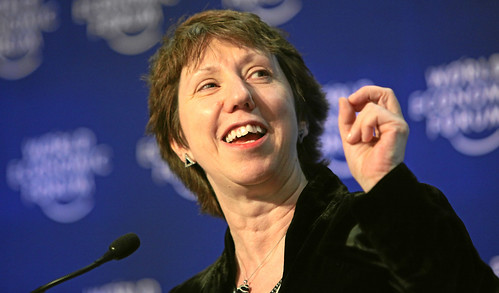
Baroness Ashton to resign? (updated)

April 30, 2010 | by David Steven | More on Europe and Central Asia | No comments

And for the EU’s latest foreign policy disaster (and one that reflects enormously badly on Gordon Brown if the story is true), the Telegraph claims that Baroness Ashton is on the brink of resigning after only months in her job:

“Every day is an uphill struggle,” said a European Commission official. “No one predicts she can stay five years, not even she.”

Lady Ashton has come under fire from powerful countries led by France, for allowing the Commission to seize too much control of a new EU diplomatic service that she is building from scratch.

Her lack of political authority has been blamed for a failure to stamp out bureaucratic Brussels in-fighting over who will control the new European External Action Service, with 7,000 diplomats manning over 130 embassies around the world.

Bitter turf wars over budgets and senior posts mean the diplomatic corps will be delayed, a situation that has angered governments and embarrassed the EU on the global stage.

Following one recent row, she allegedly threatened to walk out of her job and had to be talked out of resigning on the spot by diplomats and officials.

Of course, this may be wishful thinking by the Telegraph, but it’s another shocking misstep if true…

Update: And the plot thickens. According to the Daily Mail, Peter Mandelson is floating the resignation rumours because he expects to be Foreign Secretary and needs to find a job for David Miliband.

An Ashton aide told the MailOnline the report had ‘Mandelson’s fingerprints all over it.’ Mandelson wants to force Ashton to resign and hand over the EU job to David Miliband, the source said.

Miliband, the Foreign Secretary, was offered Ashton’s job last year but refused it, reportedly because he didn’t want to spend ‘years on a plane’.

But does Mandelson really expect Labour to form the next government? And how could he push Ashton out between now and Gordon Brown naming his cabinet after the election?


Popegate – the gays and foreigners did it

April 27, 2010 | by David Steven | More on UK | One comment

Today, the Telegraph plumbs new depths in its vendetta against the FCO over Popegate.

Yesterday, after quoting an anonymous threat from the Vatican to cancel the Papal visit, it was forced to admit that official sources had dismissed the memo as having “absolutely” no impact on the Pope’s plans.

Instead of backing off (having made the most of what was, even without the garnish, a good story), the paper has now doubled down in a truly despicable article that:

  • Outs the author of the memo,  23 year-old Steven Mulvain, as gay, based on his Facebook status. (I wonder how the paper got that information? Surely, Mulvain didn’t have a completely open profile.)
  • Names Mulvain’s boss – Anjoum Noorani - printing his photo to ensure that readers are in no doubt that Noorani is (gasp) a member of an ethnic minority.
  • Hassles Noorani’s mother (!) in Windsor, as if she is in any way relevant to the story.

Of course, the paper doesn’t come straight out and allege that the whole affair is a gay/Muslim plot, though that is clearly the implication. Instead, it complains that the FCO failed to put a Catholic in charge of the visit, rustling up another anonymous quote from the Vatican:

The most striking thing about the Foreign Office team has been how ineffectual they are. They have been disengaged and, frankly, clueless.

I have never had the impression that any members of the team were informed or even sensitive to the Catholic Church or Catholicism generally.

Gutter journalism.

Update: Damian Thompson throws some more paraffin on the fire:

The Catholic Church in this country is (a) not wildly enthusiastic about Benedict XVI, and (b) paralysed by political correctness. The four-strong FO team was led by a member of an ethnic minority and included a gay man. There’s nothing wrong with that: they could have done a fantastic job, particularly if the team had included a practising Catholic (perhaps from an ethnic community – they’re the ones who go to Mass these days). But they didn’t.

And there’s no evidence that any danger signals were spotted by Eccleston Square, which has delegated the papal visit organisation to the Left-wing Mgr Andrew Summersgill, a Magic Circle hardliner some of whose colleagues are heavily into rainbow coalition-style politicking. (If Summersgill had been told that the FO team included an Asian and a gay guy, I can imagine him asking why the transgendered community had been left out.)


Telegraph: Impeach Obama (update x3)

March 20, 2010 | by David Steven | More on North America | 2 comments

Writing for the Telegraph, Gerald Warner argues that President Obama could face impeachment if he signs the healthcare bill:

The nasty car crash that is Obamacare is dragging down Barack Obama’s presidency. The cancellation of his visit to Indonesia and Australia to stay at home offering pork-barrel enticements to doubtful House Democrats is the kind of desperate expedient we expect from Third World dictators apprised of a potential coup at home. It advertised to the world the precarious nature of a presidency that has all but lost control.

In his obsession with his healthcare fantasy, Obama is prepared even to allow the subversion of the US Constitution. For what else is the so-called Slaughter Solution [click for an explanation]? Leaving aside the grim irony of this name being associated with legislation that seeks to promote an explosion of abortions in America by injecting billions of dollars into state support of that abomination – and thereby making every taxpayer complicit in abortion – the fact remains that the fundamental purpose of the Slaughter Solution is to bypass the American Constitution.

Expect much more of this in the coming years – especially if Obama wins a second term – with the London papers pursuing their traditional role of trailblazing stories that are not yet mainstream enough for their American counterparts to print.

Depressing though to see the Telegraph get in on the action this early in the game…

Update: With reports suggesting that deem and pass (aka the Slaughter Solution) will not now be used to pass healthcare, a constitutional challenge is now likely to be directed at the individual mandate. Wonder if Warner will update (or even tone down) his post…

Update II: More on constitutional challenges here. Michelle Malkin says the first lawsuits are imminent.

Update III: After passage of the bill, Warner doubles down:

The struggle is no longer simply to avert a corrosively socialist imposition, but to reclaim the American governmental system and democracy from an Emperor-President. The Obama healthcare coup d’état is naked Bonapartism and, as such, must be overturned.


Telegraph vs Obama

June 2, 2009 | by David Steven | More on North America, UK | No comments

Rumours have long been floating around that the Abu Ghraib photos that Barack Obama has been battling to keep secret are much more graphic than anything yet published. A week ago the Telegraph dived into the fray to confirm the story:

Photographs of alleged prisoner abuse which Barack Obama is attempting to censor include images of apparent rape and sexual abuse… At least one picture shows an American soldier apparently raping a female prisoner while another is said to show a male translator raping a male detainee.

Further photographs are said to depict sexual assaults on prisoners with objects including a truncheon, wire and a phosphorescent tube. Another apparently shows a female prisoner having her clothing forcibly removed to expose her breasts.

Shocking stuff and all the more credible because their source, Major General Anthony Taguba, conducted the original investigation of Abu Ghraib and has since played a key role in continuing to describe “a systematic regime of torture” authorised directly by George Bush. Taguba believes that there is “no doubt” that the Bush adminstration was guilty of war crimes.

The Telegraph, however, had Obama in its sights, not Bush. He’d promised to release the photos, then relented when lobbied by the military. He’d then lied about their content: “I want to emphasise that these photos that were requested in this case are not particularly sensational, especially when compared to the painful images that we remember from Abu Ghraib.” Rape? Sodomy? Not particularly sensational! It was quite a scoop.

The Obama adminstration was unamused, trying to divert attention by attacking the British meda, with an Obama spokesman describing the British press as the last place you’d look for “something that bordered on truthful news.”

The Telegraph was apoplectic, publishing three furious responses. Nile Gardiner: “‘juvenile,” an “absolute disgrace.” Toby Harnden: “a smokescreen,”  ”as arrogant as anything the Bush administration ever said about the press.” James Delingpole: “stop pooping on our lawn.”

One problem. It turns out the Taguba had been misquoted. He was referring to other photos that he’d seen – and which have already been published in 2006 – by Salon. Scott Horton, who had also been promoting the story, issued this apology:

The 44 photos subject to the ACLU lawsuit and reviewed by President Obama do not contain sexually explicit images. I regret my errors.

And the Telegraph? Well, so far it’s just kept digging. Indeed, it reported Taguba’s clear denial as confirming its story, while claiming Scott Horton’s reporting also backed them up. Apologies, as James Delingpole would no doubt put it, are clearly for “pantywaists”.

Expect more “robus”‘ reporting from the Telegraph in the future, now it’s cemented in its role as the scourge of the political class, and as it acts to correct the failings of America’s “congenitally libtard Mainstream Media.” According to Delingpole:

We don’t respect politicians any more. Not our politicians, and not yours either. Imagine how this new strain of irreverence bordering on utter contempt is going to affect our reporting of political affairs.

It’s going to be a fun ride…


The people of Sark “reap what they sow” – democracy in action

December 11, 2008 | by David Steven | More on UK | 2 comments

The Barclay twins – billionaire owners of the UK’s Telegraph newspapers and various other interests – are famously reclusive. So in the early 1990s, they bought the island of Brecqhou, which can be seen in the picture below from its (not much larger – it’s three miles long) neighbour Sark.

On Brecqhou, they built a huge castle, said to be the largest built in the 20th century, and at a cost of £60m or so. Sark’s inhabitants weren’t happy:

Round-the-clock construction is said to have polluted the pristine skies of the island, which has nary a streetlight, with a sodium glow. And size is its main architectural achievement; from the air it has been mistaken for a prison, and indeed the construction crew is said to have called it Alcatraz. One islander said of the brothers, “They have the taste of Saddam Hussein.”

In 1996, the Barclay brothers tried to declare Brecqhou’s independence. They took no services from Sark and travelled to and from their island by helicopter. They were said to resent visits from Sark’s police (when, say, a worker on their estate met an accidental death). They may also have been looking to more fully protect their financial affairs from scrutiny.

When their plans were frustrated, they began to lobby for replacement of Sark’s political system – often described as the last remants of feudalism in the Western world. Thus began a long legal battle, with the brothers fighting for what they describe as “modern democratic principles and the requirements of the European Convention on Human Rights.”

Meanwhile, they embarked on a buying spree, which saw them took control of large swathes of Sark itself. According to the FT, they bought hotels, shops, golf courses – and were said to be pushing for an end to the ban on cars (and helicopters) on the island. 

Finally yesterday, Sark’s 474 voters headed to the polls for the island’s first ever democratic election (even Afghanistan didn’t have to wait so long). You can see what the islanders made of it here. The Telegraph’s Chief Reporter, Gordon Rayner was sent to cover this momentous event. The owners of his paper, he reported, had endorsed a slate of ‘reform’ candidates. They’d better get the result they wanted or there’d be trouble:

The Barclays, proprietors of Telegraph Media Group, feel so strongly about the future of Sark that they have threatened to withdraw their multi-million pound investments in the island if pro-reform candidates do not hold sway in the new parliament.

The Barclays have invested in hotels, property and agricultural land on Sark, employing around 140 people either directly or indirectly.

But all did not go according to plan. After each of the intricate ballot papers was read out aloud, in a session lasting ten hours or so, it became clear that the Barclay’s candidates had been heavily defeated – the ‘establishment’ had gained a clear majority of seats.

So how have the Barclays reacted? Well it seems they have done just what they threatened to do – immediately close down all their businesses, throwing about a sixth of the population out of work (the island has no welfare state). The twins’ lawyer told the BBC that:

The people of Sark are reaping what they sowed the day before. They only have themselves to blame. They could have co-operated with Barclays Investment but they chose to obstruct it. It was clear the Barclays were clear on their commitment to the island with support – they got no support at all.

Sark doesn’t appear to want or appreciate the Barclays’ investment and so it doesn’t have it. The island cannot at the same time treat the Barclay family in the way that it has and expect them to continue investing large sums of money into its economy.

Sark is going back to where it was before the Barclay brothers were there.

I just heard from a BBC reporter who was not expecting his hotel to be open when he got back to it. Sark’s voters have not come up with the ‘right’ democratic answer. And they’ll be punished, it seems…

Update: Another sympathetic quote from Gordon Dawes – the Barclay twins’ lawyer:

I find it very hard, particularly at this time of year, not to wonder about the old saying to do with turkeys and whether or not they would vote for Christmas; well it seems we have our answer. I am genuinely saddened. The people of Sark have spoken.

Apparently the Barclays produced a newsletter characterising one of their opponents as a “feudal talibanist” and another as having a “socialist streak”. Can’t think why that didn’t go down well with Sark’s electorate…


URBEINGRECORDED » Discontinuity & Opportunity in a Hyper-Connected World
Great discussion of complexity and network theory and its relevance to global risks, from Chris Arkenberg

The Emissions Gap Report
This publication aims to assess the following questions: are countries’ pledges of action collectively consistent with and, if implemented, likely to achieve the 2˚C and 1.5˚C temperature goals? If not, how big is the gap between emission levels consistent with these temperature goals and the emissions expected as a result of the pledges?

The Spectator runs false sea-level claims on its cover
These claims rely on misinterpretations of scientific data so grave that even an arts graduate such as Fraser Nelson should have been able to spot them.

Europe’s Insult Diplomacy - Infographic
British Prime Minister David Cameron called French President Nicolas Sarkozy “a hidden dwarf” as part of a joke told to a journalist. German Chancellor Angela Merkel referred to Sarkozy as “Mr. Bean,” while Sarkozy called her “La Boche,” or the Kraut. Spanish Prime Minister José Zapatero is “too pink” because of the high proportion of women in his cabinet, said Italian Prime Minister Silvio Berlusconi. And Berlusconi’s opinion of the euro? “A disaster,” he said, that has “screwed everybody.”

Solar Power's Good News
The White House has challenged the solar industry to produce clean electricity at $1 per watt. It has also set a national goal to achieve 80 percent clean energy use by 2035…The good news is that researchers are racing toward that goal at an impressive rate.

BBC News - Viewpoint: Is the alcohol message all wrong?
"The effects of alcohol on behaviour are determined by cultural rules and norms, not by the chemical actions of ethanol."

Something's Happening Here - NYT - Tom Friedman
When you see spontaneous social protests erupting from Tunisia to Tel Aviv to Wall Street, it’s clear that something is happening globally that needs defining

Foreign Aid Set to Take Hit in U.S. Budget Crisis - NYTimes.com
America’s budget crisis at home is forcing the first significant cuts in overseas aid in nearly two decades

Israel - Adrift at Sea Alone - NYTimes.com
Tom Friedman bemoans "the most diplomatically inept and strategically incompetent government in Israel’s history"

Eurozone: A nightmare scenario - FT.com
How it could all go pear-shaped - your cut-out-and-keep flow chart guide

Sharp fall in poor countries' dependency on foreign aid says ActionAid report
Aid dependency among 54 of the world’s poorest countries has declined by a third over the last decade, according to a new report from ActionAid.

World environment programs in budget crosshairs | Reuters
Global conservation programs are prime targets for budget-cutting: they sit at the crossroads of two things Americans dislike spending money on, aid and environment.

Attack of the Superweed - BusinessWeek
widespread use of Roundup has led to the evolution of far-tougher-to-eradicate strains of weeds

Jon Stewart Says Rick Perry Is the Candidate Republicans Want, and Deserve
Laugh out loud funny

Global reach is the prize at Busan - Resources - Overseas Development Institute (ODI)
Jonathan Glennie and Andrew Rogerson on what you need to know ahead of the big aid effectiveness summit

When Bloggers Don’t Follow the Script, to ConAgra’s Chagrin - NYTimes.com
Ha ha ha - epic PR #fail

Obama backs down on tighter smog regulations | World news | The Guardian
In case you missed it. Yes we can...

Wikileaked cable: executions of children by US forces in Iraq
Wikileaked cable with harrowing reports of  US forces handcuffing and then killing 10 people - including children aged 5 years, 3 years and 5 months.

BBC News - Tests show fastest way to board passenger planes
The way airlines board planes turns out to be the least efficient

New sources of aid: Charity begins abroad | The Economist
"The establishment donors’ aid monopoly is finished."

Who Doomed Sarah Palin's Presidential Dream? | TPMDC
Where did it all go wrong for Sarah?

The Intergenerational Foundation
"We believe that each generation should pay its own way, which is not happening at present."

Should we have a land value tax? - MoneyWeek
Discussion of pros and cons for the UK, following an article by OECD's chief economist in Prospect

Toward a Post-2015 Development Paradigm | Centre for International Governance Innovation | Centre pour l'innovation dans la gouvernance internationale
12 new development goals are proposed to replace the MDGs from 2015 - the outcome of an IFRC / CIGI conference at Bellagio

China Gets (Needlessly) Defensive Over Famine in Africa - China Real Time Report - WSJ
Germany's Africa policy coordinator causes dispute by singling out Chinese landgrabs as a culprit in the Horn of Africa famine

Latin America: A toxic trade - FT.com
Must read broadside against probably the most stupid and avoidable public policy screw-up in recent memory: the war on drugs

The intellectual collapse of left and right - FT.com
Michael Lind on how the economic inclusion narratives of centre left and centre right are simultaneously imploding - must read

Julia Gillard back to rock-bottom: Newspoll | The Australian
Bad news for supporters of green taxes and decisive action on climate change

Oxfam’s looking for a new Head of Research
A plum role is up for grabs

The global crisis of institutional legitimacy | Felix Salmon
"Our hearts want government to come through and save the economy. But our heads know that it’s not going to happen."

UBS' George Magnus On Marxist Existential Crises And The "Convulsions Of A Political Economy" | ZeroHedge
Not every day you see investment banks publishing detailed analysis of Karl Marx

Food Prices Could Hit Tipping Point for Global Unrest | Wired Science | Wired.com
New quant research on thresholds over which high food prices cause riots

Ambassador Locke Picks Up His Own Coffee, Gains 'Hero' Status Among Chinese : The Two-Way : NPR
Some pictures of the brand new U.S. ambassador to China are causing quite a stir.

Jon Stewart | Ron Paul | Michele Bachmann | Mediaite
Jon Stewart breaks down the state of play on the Republican Presidential race

The Bucky-Gandhi Design Institution › When?
Some properly out of the box thinking from Vinay Gupta. Must-read.

England’s riots: If the UK were a fragile state… | Dan Smith's blog
By the head of a leading peacebuilding NGO

Post-Traumatic Stress Disorder From 9/11 Still Haunts - NYTimes.com
At least 10,000 New Yorkers still have PTSD from 9/11

The unlikely social network fuelling the Tottenham riots « The Urban Mashup Blog
Not Twitter, not Facebook but.... Blackberry Messenger

Mapping world food price volatility | Nourishing the Planet
Clickable map of global food price hotspots

Will the 2012 Earth Summit be a flop? > From Poverty to Power
Great summary of the state of play on Rio 2012 from Oxfam's Sarah Best

Articles & Publications
Sustainable Development Goals – a useful outcome from Rio+20?

Recent months have seen increasing interest in the idea that Rio+20 could be the launch pad for a new set of ‘Sustainable Development Goals’ (SDGs).  But what would SDGs cover, what would a process to define and then implement them look like, and what would some of the key political challenges be? This short briefing [...]

Creating Consensus on a post-2015 framework for development

Any global framework for development which is agreed after 2015 will be a political deal between states. This paper looks at recent trends in policy and politics in emerging economies and traditional donors to assess where a consenus might lie. It suggests some principles for a post-2015 agreement which emerge from recent policy developments

A post-2015 Global Development Agreement: why, who what?

Paper from ODI and UNDP, authored by Claire Melamed and Andy Sumner, summarising the evidence on the impact of the MDGs, and looking at current trends in poverty and in global governance that will affect the shape and the scope of any future agreement on global development.

Resource Scarcity, Fair Shares and Development

Why resource scarcity will be a game changer for global justice agendas, and what aid donors, NGOs and other development opinion formers need to do about it. WWF / Oxfam report by Alex Evans.

Making Rio 2012 Work: Setting the stage for global economic, social and ecological renewal

The Rio 2012 sustainable development summit is at risk of being the latest in a long line of damp squibs on environmental multilateralism – but could still make real progress, if it focuses on greening growth and building resilience to shocks and stresses, and above all faces up to the issues of fair shares that arise in a world of limits.

Governance for a Resilient Food System

How national and international governance systems need to be reconfigured to meet the challenges of food security in a world of tighter supply and demand balances and increasing volatility. Report for Oxfam’s new Grow campaign by Alex Evans. (May 2011)

Running out of everything: how scarcity drives crisis in Pakistan

Article on scarcity of resources in Pakistan and what it means for the country.

Economics for a world with limits

Text of speech by Alex Evans to Institute for New Economic Thinking annual conference at Bretton Woods; the YouTube video is here. (April 2011) Download Speech

Unscrambling the price spike

Article published on China Dialogue on reasons for the new food price spike, including potential implications of the current drought in China. (February 2011) Download Article

2020 Development Futures

Eight critical uncertainties for development over the next decade, and ten recommendations for what ActionAid – who commissioned this report – should do to prepare for them

American Foreign Policy in an Age of Uncertainty

Article published in World Politics Review on current American foreign policy

The World in 2020 – Geopolitical and Trends Analysis

Report asking how organisations can prosper in what will be a turbulent period for world order

Globalization and Scarcity

Center on International Cooperation report on what forms of multilateral cooperation are needed to manage scarcity of resources

Resource Scarcity, Climate Change and the Risk of Violent Conflict

Background paper on whether resource scarcity and climate change will cause increased violent conflict

Organizing for Influence: UK Foreign Policy in an Age of Uncertainty

Chatham House report on how the UK’s new coalition government should upgrade and reform the way Britain conducts foreign policy

The Long Crisis Seminar

Introductory remarks by David Steven at a Brookings Institution seminar on risk and resilience in the global system (March 2010)

Stop Betting the House talk

Talk given by David Steven at Gresham College on risk and resilience in the UK housing market, as part of a Long Finance Roundtable meeting (March 2010)

Time to Stop Betting the House: a response to the FSA

Report by David Steven in response to the FSA’s Mortgage Market Review

Confronting the Long Crisis of Globalization: Risk, Resilience and International Order

Brookings Institution report by Alex Evans, Bruce Jones and David Steven on how globalisation could fail – and how it could be made more resilient. Published to coincide with the 40th anniversary World Economic Forum in Davos.

Hitting Reboot – where next for climate after Copenhagen

Report by Alex Evans and David Steven analysing the post-Copenhagen context on climate change, including a proposed 12 point action plan. Written for the Brookings Institution / NYU Center on International Cooperation Managing Global Insecurity programme.

Climate Change and Hunger: Responding to the challenge

World Food Programme report on the state of the science on what climate change means for hunger, plus policy recommendations. Authored by IPCC Impacts Chair Martin Parry with Mark Rosengrant, Tim Wheeler and Global Dashboard’s Alex Evans (December 2009)

Scarcity, security and institutional reform

Presentation by Alex Evans to a seminar organised for the UN Department of Political Affairs by the Geneva Centre for Security Policy (August 2009)

The Resilience Doctrine

Article on risk and resilience by Alex Evans and David Steven – part of a special in World Politics Review on risk and resilience in a globalized age (July 2009)

An Institutional Architecture for Climate Change

Report by Alex Evans and David Steven exploring the future international institutional requirements for managing climate change, and including three scenarios for climate institutions between now and 2030. Commissioned by the UK Department for International Development. (May 2009)

Risks and Resilience in the New Global Era

Article by Alex Evans and David Steven exploring resilience as a political agenda – part of a special edition of Renewal on the transformation of foreign policy (February 2009)

A Tale of Two Cities

Climate and cities think piece, co-authored by David Steven and the British Council’s Peter Upton (29 January 2009)

The Feeding of the Nine Billion

Chatham House pamphlet by Alex Evans on how scarcity issues will shape the outlook for global food production, and the actions that policymakers need to take at the international level and in developing countries to ensure food security in the 21st century

2009 – A Year for International Reform

Paper by David Steven, presented to “Reforming International Institutions – Meeting the Challenges of the 21st Century,” a conference organized by the United Nations University and the British Embassy in Tokyo (Jan 2009).

Food prices: what next?

Speech by Alex Evans at the Tomorrow Network (25 November 2008)

A Bretton Woods II Worthy of the Name

Paper by Alex Evans and David Steven on financial reform and wider multilateralism, published ahead of the G20 ‘Bretton Woods II’ Summit (November 2008).

The Future of Resilience

Speech by David Steven to RUSI Conference on UK Resilience (8 October 2008)

Towards a Theory of Influence

Chapter by Alex Evans and David Steven in the Foreign & Commonwealth Office publication, ‘Engagement: public diplomacy in a globalised world’ (July 2008). Download Chapter

Multilateralism for an Age of Scarcity

Draft report by Alex Evans exploring multilateral system reforms needed in order to manage resource scarcity issues more effectively. The final version will be published in early 2010 (July 2008)

Scarcity issues and conflict in Africa

Speech by Alex Evans at UK Parliament (8 July 2008)

A Low Carbon World – Pathways to a Global Deal

Speech by David Steven at the UNU G8 Symposium (4 July 2008)

Climate, scarcity and multilateralism

Speech by Alex Evans to United Nations Association UK (7 June 2008)

The new public diplomacy and Afghanistan

Speech by David Steven to the UK Defence Academy’s Advanced Research and Assessment Group seminar on Strategic Communications, Public Diplomacy and Afghanistan (4 June 2008).

Technology and Public Diplomacy

Speech by David Steven to the University of Westminster Symposium on Transformational Public Diplomacy (30 April 2008).

Rising Food Prices: Drivers and Implications for Development

Briefing paper by Alex Evans, published through Chatham House’s food programme (April 2008).

Looking Forward: how do we build resilience?

Speech by David Steven to RUSI Conference on Critical National Infrastructure (16 April 2008).

Shooting the Rapids: multilateralism and global risks

Paper by Alex Evans and David Steven, commissioned by Gordon Brown and presented to heads of state at the Progressive Governance Summit (April 2008).

Beyond a Zero-Sum Game on Climate Change

Chapter by Alex Evans and David Steven, as part of the British Council’s Transatlantic Network 2020 book ‘Talking Trans-Atlantic’ (March 2008).

From Bali to Copenhagen: towards an endgame for global climate policy?

Article by Alex Evans for the Environmental Policy & Law Journal (January 2008).

Climate Change: The State of the Debate

Report by Alex Evans and David Steven, written for the London Accord (December 2007).

The Post-Kyoto Bidding War: bringing developing countries into the fold

New paper by Alex Evans on climate policy after 2012 from the Center on International Cooperation (October 2007).

Alternative CSR: the Foreign & Commonwealth Office

Chapter on the FCO from Manchester University Press’s Alternative Comprehensive Spending Review, by David Steven (September 2007).

Fixing the UK’s Foreign Policy Apparatus: A Memo to Gordon Brown

Note by Alex Evans and David Steven about how to restructure the UK’s foreign policy system in order to manage trans-boundary global risks better (April 2007).

Evaluation and the New Public Diplomacy

Talk given by David Steven at the Wilton Park conference: The Future of Public Diplomacy. Focuses on strategies to drive public diplomacy to the heart of the foreign policy armoury (March 2007).

Articles and Publications

YouTube Preview Image

Gabrielle Giffords to step down | 2 Comments

YouTube Preview Image

Oh to be in the president of Turkmenistan’s entourage… | 1 Comment

YouTube Preview Image

David Carr And Danah Boyd Share Insights | Comments Off

YouTube Preview Image

Edgar Mitchell on the Overview Effect | 1 Comment

YouTube Preview Image

Presidential debate fail | 2 Comments

More What we're watching

Key Posts
Cheap food: bad. Expensive food: terrible. Why the FAO’s glass is always empty8

It’s interesting to look back a few years – to when the world was worried that food was too cheap, not too expensive. In 2004, the UN Food and Agricultural Organization looked back on a long bear market for food: forty years in which real prices of agricultural commodities had fallen 2% per year, or [...]

How many people are hungry?3

The good news: poverty is in retreat. The bad news: hunger isn’t.  That’s the headline finding for the first Millennium Development Goal , which aims to halve the proportion of people living on less than $1.25 a day and the proportion of people living in hunger between 1990 and 2015. Great strides have been made [...]

“Freeing the entire human race from want”2

The MDGs are so over Having just been rude about one World Bank report, here’s a positive review of another – the Global Monitoring Report 2011, which the Bank produces jointly with the IMF. The GMR updates progress against the Millennium Development Goals – targets that were set as the culmination of a push throughout [...]

21 years ahead of its time5

A 1989 article on ‘the global teenager’ in Whole Earth Review was way ahead of its time in identifying the crux of what today’s youth bulge means for global change

Is it time for Sustainable Development Goals?5

The pros and cons of a new global set of Sustainable Development Goals (SDGs) – and how they might work in practice

The one book you must read over the summer9

Mark Lynas’s new book The God Species is a must-read for environmentalists

Fair shares in a world of limits: the new front line for development-

Thoughts after from a joint WWF / Oxfam seminar on resource scarcity, fair shares and development.

What the ‘powershift’ narrative overlooks on US-China relations-

The ‘powershift’ narrative about US-China relations obscures how much they have in common: unsustainable growth paths, shaky financial sectors, political sclerosis, massive inequality, reliance on imported resources and above all their status as the two principal obstacles to collective action on shared global risks.