by Mark Weston | Nov 13, 2012 | Africa, Climate and resource scarcity, Economics and development
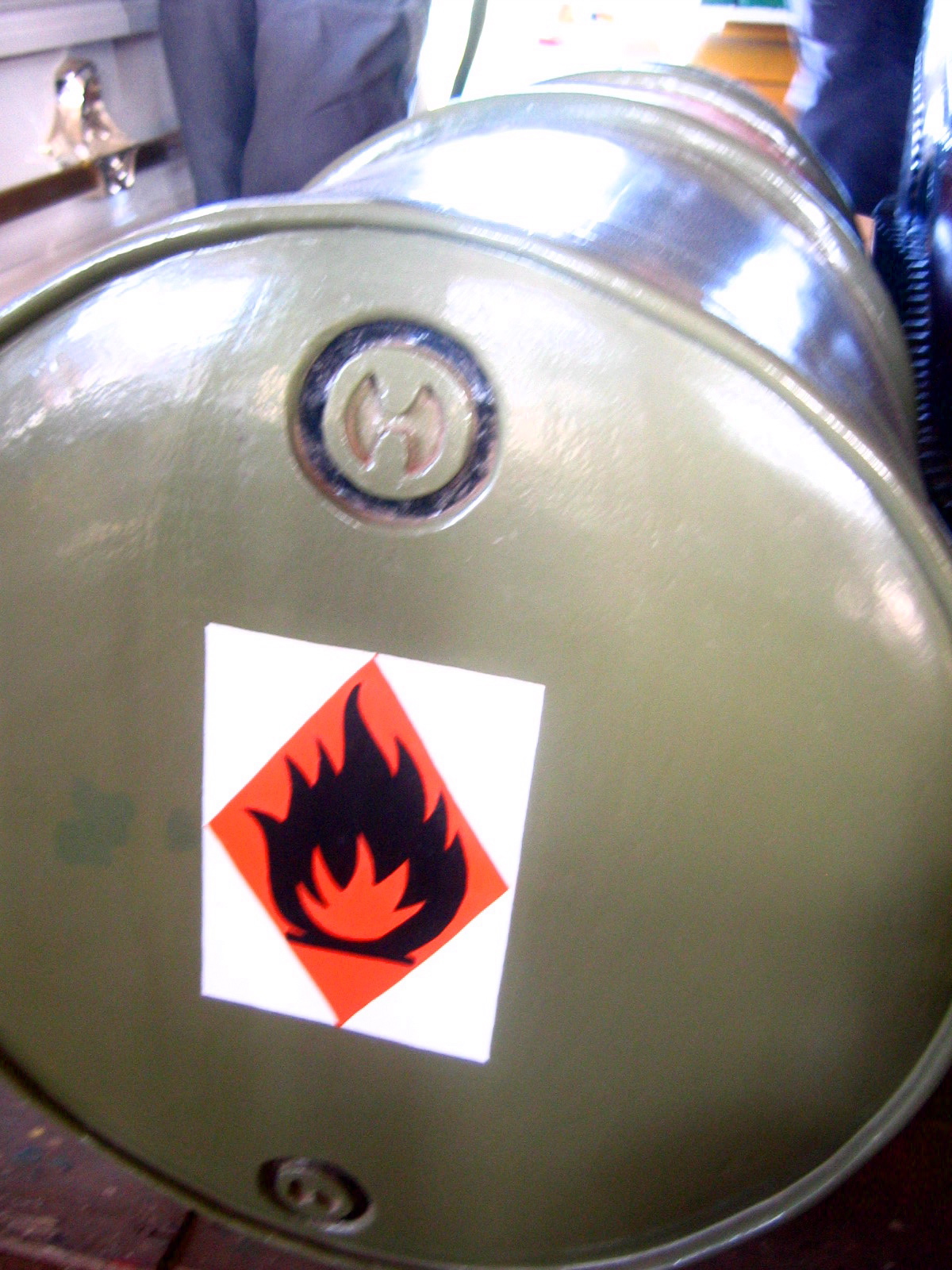
Oil barrel coffin, Ghana (photo courtesy Flickr user What KT Did)
In The Ringtone and the Drum, my recently published book on West Africa, I described how diamonds have proved a curse rather than a blessing to Sierra Leone:
Once the resource curse falls on a country, like a deadly virus it spreads rapidly, crippling its host’s every organ, paralysing its every function. First to suffer are farming and manufacturing. The profits from diamonds (or oil or gold) far outweigh those achievable through agriculture or industry, and it makes economic sense to allow mineral extraction to become the dominant productive activity. Often it becomes the sole productive activity. Diamonds give a country’s leaders more wealth than they ever dreamed of, so they no longer need to worry about other parts of the economy. Minerals become the only way to make a living; everything else is left to rot. As other, more labour-intensive sectors collapse, the majority of the population has no work (the decline of Sierra Leonean agriculture was swift: twenty years after discovering its precious stones, the country had gone from exporting rice to importing it). A chasm opens up, between the rich few with access to mineral wealth, and the poor masses who are shut out.
The masses have no outlet for their frustrations, no way of redressing the balance. While they are growing rich on diamond exports the leaders of a resource-cursed country do not need to agonise over what their subjects think of them. Governments in countries lacking in valuable minerals depend on taxes to keep them in business; without them, ministers would not be paid and the machinery of government could not function. For taxes to be paid, the state must count on at least some degree of support from its citizens, and is to some degree answerable to them – if it ignores their needs entirely, citizens will use non-payment of tax as a bargaining chip. But in diamond-rich economies, governments need nothing from their people; profits from the gems are more than sufficient to keep the leaders in luxury, and their subjects, lacking any leverage over them, have no way of agitating peacefully for a fair share of the pie.
Sierra Leone’s near-neighbour Ghana, the world’s newest oil producer and one of its fastest growing economies, has so far avoided damage to non-oil sectors, but last week brought a worrying sign that politicians are keen to get their hands on oil revenues. By itself, and even though inflation in the country is running at just 9%, members of parliament awarding themselves a 140% pay rise may not be cause for tremendous alarm – Ghanaian MPs’ monthly salary of $3,800 is still much lower than that of their Kenyan counterparts, for example, who trouser a cool $10,000 a month.
But it is difficult to understand why such a pay rise should be backdated to 2009. Such a ruse means that in January next year, lawmakers will receive a windfall of $109,025 (the $2,225 pay rise multiplied by 49 months). Ordinary Ghanaians who are struggling to make ends meet are unlikely to be aware of the full extent of the politicians’ good fortune, but if they did have time to do the calculation they would receive a nasty shock: it would take a Ghanaian on the minimum wage 121 years to earn what MPs have just gifted themselves.
by David Steven | Mar 5, 2012 | Economics and development
With Brent bumping up against the $125 mark and petrol/gasoline prices at record highs, many commentators are once again assuming that high prices are the new normal. Maybe. But perhaps not. Here are seven reasons why oil could see a sharp fall.
- High prices are being driven by fears of war with Iran. But we’ve been there before. Back in 2009, many were hyping a military strike and nothing happened. If markets get bored of waiting and begin to discount fears of an imminent attack, oil’s risk premium could shrink fast.
- Higher prices are bringing more oil onto the market. Iraq is now producing more than at any time since 1979 and hopes to quadruple production by 2017. Saudi Arabia has doubled the number of rigs it has deployed. Offshore exploration is picking up as memories of the Deepwater disaster fade. Remember too that we’re yet to see the full supply response to the 2008 spike.
- At the same time, demand is being choked off by high energy prices. Oil helps explain why the US recovery is so anaemic. Meanwhile, both China and India have revised their growth projections downwards. HSBC has dubbed oil ‘the new Greece’ – catchy, an exaggeration, but at least somewhat true.
- Oil prices are putting import-dependent emerging and developing economies under growing fiscal pressure. In India last week, I was taken aback at how vulnerable high energy prices have made the country’s government. Energy and food subsidies have driven the deficit to an expected 5.6% of GDP this year. Many countries will have to cut expenditure or subsidies, or raise taxation somewhere along the line (and face the political consequences of these actions).
- The United States is importing less oil than at any time since 1999 – in part due to lower demand (changes in consumer behaviour due to the 2008 price spike are still filtering through the system) and in part due to resurgent domestic supply (tight oil etc.). Together with its growing shale production, this represents a significant shift in the pattern of demand.
- Speculative pressures appear to be pro-cyclical and could unwind rapidly. Oil consumers are hedging (or trying to) against an Iranian supply shock, while pension and index funds are betting that oil will go higher. A change in sentiment could lead to a sudden bout fall in the price, as trade in paper-based oil exacerbates, rather than controls, market risk.
- It’s happened before. Brent was above $145 in July 2008. It then fell to $54 in just six months. Admittedly, the bottom had fallen out of the world economy and we seem to have stepped away from imminent catastrophe in the Eurozone, but the historical precedent should still dent the confidence of those who assume that, for oil, the only way is up.
So will oil fall? Much depends on what happens with Iran, of course. Other supply shocks could play a role, which is why reports of an attack on a Saudi pipeline caused palpitations last week, and why MEND’s seeming resurgence in Nigeria is causing concern.
Oil exporters, meanwhile, are desperate to keep prices high(ish). Their fiscal breakeven points are now worryingly high, as governments use oil revenues to buy off restive populations. Saudi Arabia needs oil above $80 and Iraq above $100 before they start eating into surpluses or running up debt. In Russia, Putin’s tears of triumph may flow for less happy reasons: the Finance Ministry says it now needs S117 oil. Don’t expect to see them rushing to flood the market with supply.
And oil is clearly riskier and more expensive to produce than it was in the long, long bear market that followed the East Asian financial crisis. In the medium term, a new floor is probably being set for the oil price, determined by the cost of production for tight and deep sea oil, and for tar sands, and for opening up resources in some of the world’s least stable states. That floor, though, could be somewhat, or even considerably lower, than the current price.
My sense is that we can expect to see an extension of the current period of volatility. The scenario where prices jump again is realistic, but so is one where we see a lurch downwards. The market seems pretty frothy to me, and too many analysts have jumped uncritically on the high price bandwagon.
Policymakers need to continue to plan for unusually high levels of uncertainty. And they should be sure to ignore the false prophecies of those who claim to know what the oil price is going to do.
by Alex Evans | Feb 25, 2011 | Climate and resource scarcity, Economics and development, Middle East and North Africa

Ever heard of spare capacity theory? It’s defined by Gregor Macdonald as:
the assumption among western bankers, policy makers, economists, and stock markets that OPEC producers can lift oil production at will, and, export all of that spare production to world consumers.
(See also this recent post on Global Dashboard, and this one from back in 2008.) There’s a lot of spare capacity theory doing the rounds at the moment, given what’s happening in North Africa and the Middle East. Libya normally produces 1.6 million barrels of oil a day (a little under 2% of global production). It’s estimated that about 350,000 barrels, or 22%, of that is now offline, and depending on how things pan out, it could stay offline for some time.
Now imagine what happens if it all kicks off in Algeria (a larger exporter than Libya of oil plus oil products). Or, for that matter, in Iraq, Iran, or Saudi Arabia – all of which are much more significant again. That’s what has traders and futures markets spooked, and everyone looking to Saudi Arabia: as a source quoted in the FT this morning puts it,
“It is fear of the unknown. The risks are all to the upside. Saudi Arabia needs to respond.”
Saudi Arabia, for its part, insists that it can and will increase production if needed:
“Right now, there are active talks in order to implement what is needed,” the Saudi official said. He stressed that the kingdom retains spare capacity of some 4m barrels a day – more than double Libya’s entire output, which totalled 1.58m b/d in January, according to the International Energy Agency.
Saudi Arabia has not yet decided whether to increase production. If it proved necessary to produce more, “then that will happen, there’s no problem at all”, the official said.
But what if that’s not true? Gregor Macdonald argues that the extent to which markets have climbed over the past week “suggests the market is justifiably concerned about events in Libya, and the risk of more unrest to come in oil producing regions”. His conclusion:
Given the potential magnitude of this situation, I actually think its good that we can still rely on price as a means to ration supply.
True though that may be, a new oil price spike is exactly what we didn’t need on global food prices at this point. Back at the start of the year, the fact that we weren’t in the middle of an oil spike was one of the factors I drew comfort from on the food outlook. Not now…
by Alex Evans | Jan 16, 2011 | Africa, Climate and resource scarcity, Conflict and security
A propos of Richard’s post on how the French used to behave in Cote d’Ivoire, let’s not forget how another member of the Security Council P5 – Russia – is behaving right now. Why, you might wonder, should Russia be blocking moves in the Security Council to step up the international community’s level of intervention in Cote d’Ivoire?
Concerned about implications for its own restive regions, such as Chechnya, Russia has traditionally sought to thwart Security Council actions regarding nations’ sovereignty. But one western diplomat said Russian considerations over Ivory Coast were “90 per cent about oil, 10 per cent about sovereignty”.
Lukoil, Russia’s second biggest oil producer, has stakes in three deep-water blocks off the Ivorian coast, part of a largely untapped 1,000km oil frontier. Lukoil acquired its interests during Mr Gbagbo’s rule and changes of power in Africa have often been followed by reviews of oil and mineral rights.
by Alex Evans | Sep 28, 2010 | Climate and resource scarcity
Back in 2008, just as the oil price started to plummet after hitting its all-time high of $147 a barrel, I did a post pondering whether the drop was “the start of a long decline, or just a brief pause to draw breath before a resumption of the relentless upward march of recent years”. I argued that oil prices would stay low as long as the credit crunch lasted, but that
once we’re through the crunch, we may be back to a game of cat and mouse between oil supply and economic growth. Demand falls, oil price falls; demand picks up, oil price goes back up too – but never for long enough to give investors a clear signal to pump cash into new oil supply infrastructure
Over at the Energy Bulletin, Dave Cohen’s just published a post thinking about the same question – and wondering when the next oil spike is due. His take is that the next crunch will likely be in 2013, give or take a year, as his graph below illustrates:

As Dave notes, this graph is not a forecast on oil prices, but rather a schematic illustrating that a) demand surges cause oil price shocks [i.e. the peaks on his graph]; b) oil price shocks cause recesssions and force reductions in demand [the troughs]; and c) the average price of oil goes up over time [the straight line]. Informally, he notes, “we can say there’s been an oil price shock when the real (inflation-adjusted) price goes over $100 per barrel and stays there for at least 2 months”.
His whole post is worth reading (n.b. especially his emphasis on the key variable in all this, namely prospects for Chinese growth) – and leaves the reader wondering: how do we break out of the cycle?
As I argued back in 08, one answer could be massive new investment in oil production – remember the IEA’s consistent warnings throughout the downturn about how under-investment in new oil production is setting the stage for a new supply crunch. But there are two problems with that option. One: we’re into diminishing returns territory. With the age of easy oil over, production increases from now depend on unpalatable options like tar sands, oil shales and, ahem, a lot more deepwater drilling (which is projected to account for 40% of global oil demand by 2020). Two: this approach does nothing to solve climate change.
So, I concluded 2 years ago, “it looks like the only way through is for policymakers to agree a global climate policy framework that’s both global in scope and sufficiently long term to provide investors with an unequivocal signal of where to put their cash: this is the only way of squaring energy security with climate change”.
I still think that’s right – but obviously, prospects for that have dimmed considerably since Copenhagen. So where does that leave us? That leaves us, alas, stuck in the yo-yo world depicted in Dave’s graph (which looks a lot like the Multilateral Zombie climate policy scenario that David and I described in our 2009 report for the UK government on global climate architecture – see page 7 onwards).
Oh – and it also leaves us on track for 3 degrees plus of global warming.
