by Ryan Gawn | Nov 8, 2015 | Cooperation and coherence, Global system, Influence and networks, UK
This is the third in a series of blogs on the upcoming Spending Review, and how Britain maximises its influence and soft power across the world at a time of declining budgets. This focuses on the BBC World Service, “Britain’s gift to the world”. Find the others with the following links: FCO, British Council.
Other UK soft power assets fall into the “unprotected” category and are at risk of cuts. Since the Chatham House / YouGov Survey began polling in 2010, BBC World Service radio and TV broadcasting has been seen by UK opinion-formers as the UK’s top foreign policy tool, consistently ranking higher than all other foreign policy “assets”.
Broadcasting to 210m people every week and with a budget less than half that of BBC2, the World Service faces increasing challenges in the form of domestic and international competition, technical change, and a legacy of underinvestment. FCO funding was cut by 16% in 2010, leading to the departure of about a fifth of  its staff. This has had an impact – in 2005 the organisation provided services in 43 languages, now down to 28. In contrast, there is increased competition – following a 2007 directive from Premier Hu Jintao, China has been investing heavily in soft power assets with state journalists now pumping out content in more than 60 languages. Lacking first mover advantage, it is clear that competitors have strategic ambitions. Yu-Shan Wu of the South African Institute for International Affairs comments, “Since the Beijing Olympics, we have seen increased efforts to provide China’s perspective on global affairs, signalling relations with Africa have moved beyond infrastructure development to include a broadcasting and a people-to-people element. There are now regular exchanges between Chinese and African journalists, and it is clear that China is stepping up and laying the foundations for a more concerted public diplomacy effort in the region.”
From April last year, the World Service ceased to be funded by the FCO, and is now resourced by a share of the BBC licence fee. Although its budget was increased by the BBC in 2014 (up by £6.5m to £245m), the BBC itself faces many of its own funding challenges. In July, the Chancellor called on the organisation to make savings and make ‘a contribution’ to the budget cuts Britain is facing. Ministers asked the BBC to shoulder the £750m burden of paying free licence fees for the over-75s, and later that month unveiled a green paper on the future of the broadcaster which questioned if it should continue to be “all things to all people”. In the same month, the organisation announced that 1,000 jobs would go to cover a £150m shortfall in frozen licence fee income.
The World Service is somewhat insulated from wider BBC cuts, as the BBC has to seek the Foreign Secretary’s approval to close an existing language service (or launch a new one). Nevertheless, in early September, Director-Genera l Tony Hall made the first of a series of responses to the green paper. Making a “passionate defence of the important role the BBC plays at home and abroad”, he unveiled proposals for a significant expansion of the World Service, including; a satellite TV service or YouTube channel for Russian speakers, a daily news programme on shortwave for North Korea, expansion of the BBC Arabic Service (with increased MENA coverage), and increased digital and mobile offerings for Indian and Nigerian markets. Interestingly, the proposals sought financial support from the government, suggesting matched funding, conditional upon increased commercialisation of the BBC’s Global News operation outside the UK.
More on the expansion plans here.
by Ryan Gawn | Sep 6, 2015 | Global system, Influence and networks, UK
The BBC World Service is often seen as one of the UK’s great soft power assets. Former UN Secretary-General Kofi Annan agrees, describing the world’s largest international broadcaster as “perhaps Britain’s greatest gift to the world”.

Tomorrow will see Tony Hall, BBC Director-General, set out the first of a series of responses to the government’s green paper on the future of the broadcaster – a “passionate defence of the important role the BBC plays at home and abroad”. The green paper opened up plenty of issues for discussion (aims, funding, license fee, digital approach etc.), but tomorrow’s response is expected to focus on some rather bold expansion proposals for the World Service. Bold because the BBC has already been asked to make cuts and shoulder the £750m burden of paying free licence fees for the over-75s. And also bold because they are explicit in seeking to counter the challenge of state-sponsored rivals, such as Qatar’s Al-Jazeera, Russia’s RT and China’s CCTV.
“This is about Britain’s place in the world… …It is above the politics of the debates about the BBC’s future. It has to be a national priority. Other news outlets are growing globally and many do not share our traditions and values. We have a strong commitment to uphold global democracy through accurate, impartial and independent news.”
A cursory glance at the expansion plans give a good indication of priorities / challenges:
- satellite TV service or YouTube channel for Russian speakers
- daily news programme for North Korea
- expansion of the BBC Arabic Service (with increased MENA coverage)
- increased digital and mobile offerings in India and Nigeria
But how real are these challenges? Very, actually, especially if you, like 68% of opinion formers, consider the World Service to be one of the UK’s most important foreign policy assets, or are concerned about the strategic decline of the UK’s soft power.
Firstly, the World Service faces a legacy of underinvestment. With a budget less than half that of BBC2, FCO funding was cut by 16% in 2010, leading to the departure of about a fifth of its staff. This has had an impact – in 2005 the organisation provided services in 43 languages, now down to 28. Some services have been ceased, and at one stage, audiences of 10 million in India were under threat for the sake of £900,000.

Secondly, and more importantly, the organisation faces increased competition with the news / information arena seeing increased investment by state-sponsored broadcasters – a “soft power battle”. The BBC sounded the alarm bell in January with its Future of News report highlighting the disparity in investment seen elsewhere – “China, Russia and Qatar are investing in their international channels in ways that we cannot match, but none has our values and our ability to investigate any story no matter how difficult.” Compared to the World Service’s £245m budget (2014), both competitor investment and aspiration levels are high. China’s CCTC received nearly $7bn to expand global operations and both RT (previously named Russia Today, the Kremlin-backed news service, $300m budget), and Qatar’s Al Jazeera ($100m budget) recently launched channels targeting UK / English-language audiences. Before being named UK Culture Secretary, John Whittingdale said it was “frightening” that the World Service was being “outgunned massively by the Russians and the Chinese”. 
The report also warned of ‘dangerous and disparate’ threats to independent and reliable world news from other well-funded state broadcasters, arguing that cuts would reduce the UK’s influence, “The World Service faces a choice between decline and growth… …If the UK wants the BBC to remain valued and respected, an ambassador of Britain’s values and an agent of soft power in the world, then the BBC is going to have to commit to growing the World Service and the government will have to recognise this.”
With ministerial discussions on the Autumn spending review already well underway, we can expect further lobbying and positioning in advance of the November announcement on departmental settlements. More on this in my forthcoming Chatham House article on how Britain maximises its influence across the world at a time of declining resources.
by Ryan Gawn | Jul 22, 2015 | Conflict and security, Cooperation and coherence, Global system, Influence and networks, UK
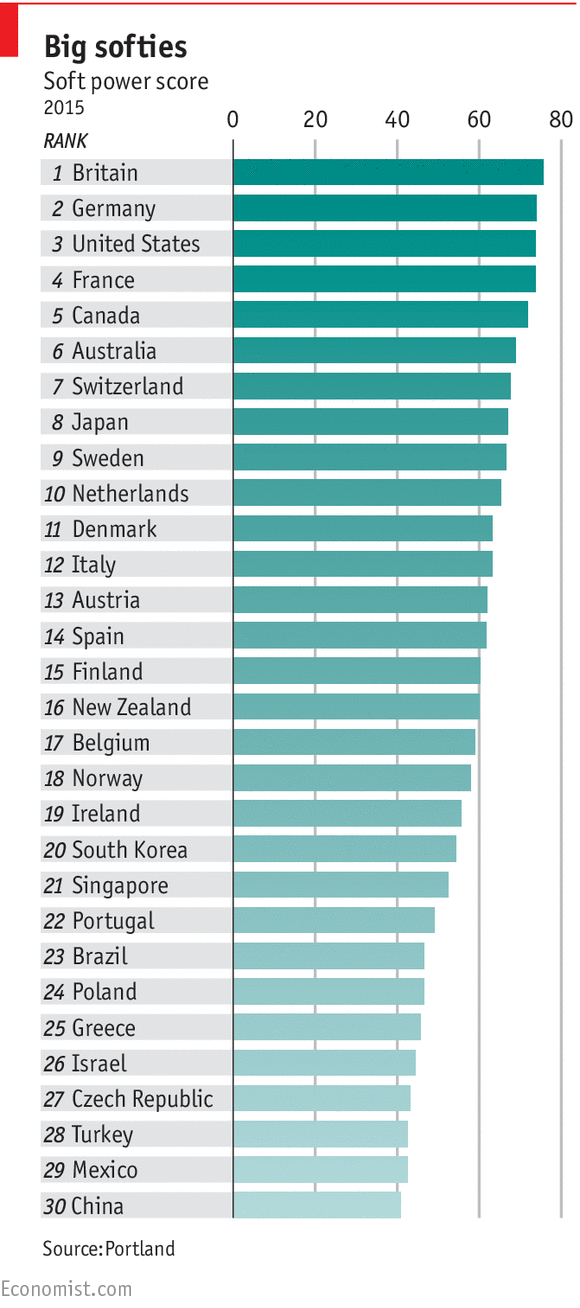
Last week saw the launch of a new global #softpower report, ranking the UK at the top of a 30-country index. Compiled by Portland, Facebook and ComRes, the report is described by Joseph Nye (who coined the term in 1990) as “the clearest picture to date of global soft power”, and has ranked countries in six categories (enterprise, culture, digital, government, engagement, education).
There are quite a few of these indices around now, with varying methodologies – nevertheless, this is the first to incorporate data on government’s online impact and international polling. Who’s at the top of the tables isn’t really surprising (the top 5 countries – UK, Germany, US, France, Canada – are identical to the top 5 in the Anholt-GFK Roper Nation Brand Index, but with a slight reordering of ranking). The US, Switzerland and France topped the specific categories, and although not first place in any of the categories, the UK ranked highest overall, reflecting its strength in culture, education, engagement & digital. More on the UK later.
What is really surprising is that China finishes last. Following a 2007 directive from Premier Hu Jintao, China has been investing heavily in soft power assets (such as the Xinhua news agency, aid/ development projects), at a time when others have been paring back their ambitions. Nevertheless, the impact of this investment isn’t borne out in the results, likely hindered by negative perceptions of China’s foreign policy, questionable domestic policies and a weakness in digital diplomacy. China came out strongest in the culture, likely reflective of the many Confucius Institutes dotted around the globe.
There are a few other interesting nuggets:
· Broader power trends are increasing the need for soft power – 3 factors driving global affairs away from bilateral diplomacy and hierarchies and toward a much more complex world of networks:
1. Rapid diffusion of power between states
2. Erosion of traditional power structures
3. Mass urbanisation
(more…)
by Alistair Burnett | Jun 27, 2014 | Global Dashboard
Today, President Petro Poroshenko signed the EU Association Agreement and Russia has warned of grave consequences. Of course, it was the refusal of Poroshenko’s predeccesor Victor Yanukovich to sign this Agreement last November that triggered the protests that led to his overthrow and Russia’s annexation of Crimea in February.
Since then, the veering from angry stand-off to telephone diplomacy and back again between the West and Russia over the future of Ukraine resembles a dialogue of the deaf.
This was underlined this week at an on-the-record debate on the Ukraine dispute at the foreign affairs think tank, Chatham House, in London.
The Russian strategic analyst and former Red Army Colonel, Dmitri Trenin – with more than a hint of irony – bemoaned a surfeit of ideology in western foreign policy. He made this observation in relation to a discussion over whether Russia would ‘allow’ Ukraine to join the EU and/or NATO.
The Canadian Liberal MP, Chrystia Feeland, had argued that Ukraine is in the throes of a democratic revolution and the Ukrainian people have the right to decide if they want to join either of the western clubs. The American Realist international relations professor, John Mearsheimer, insisted, bluntly, rights don’t come into it – Russia is the great power in the region and will wreck Ukraine rather than allow it to make that choice.
The former US Ambassador to Russia, Mike McFaul, the other participant in the debate, and Ms Freeland were visibly bemused by this argument which was indicative of what I think Trenin was getting at.
Western foreign policy makers seem to be prone to wishful thinking – that the rest of the international community shares their worldview and that values should outweigh core national interests.
This means, for instance, that what Washington sees as its ‘rebalance’ or ‘pivot’ to Asia, which, it asserts, will benefit Asia and the US economically and help ensure peace and stability in the region, is seen very differently in Beijing. It is clear that China is suspicious of the ‘pivot’ and many there regard it as an attempt to contain them and stifle growing Chinese power and influence in its own backyard. American policymakers insist this is not the case and express surprise their Chinese counterparts could possibly think such a thing.
In the case of Russia, the Americans and Europeans insist Russia has nothing to fear from a Ukraine that chooses to be in the western camp and that it can be a win-win for all, and this is sometimes expressed as incredulity that Moscow can’t see this.
Cynics may argue that this attitude is feigned given the Americans know they would not accept a country like Mexico allying itself with another great power, but in many cases it isn’t – reflecting what appears to be an assumption in US circles, perhaps resulting from the post-Cold War period of American global dominance, that what is in its national interests is in everyone else’s too.
If you add to this that Washington is also having to adjust to the shift in the global balance of power, which has seen the return of what commentators like Professor Mearsheimer see as great power politics, when countries like Russia and China assert their interests, it often meets with incomprehension in the US.
As for the Europeans who have spent the last sixty years trying to shed the great power mindset that fuelled two world wars which killed tens of millions, and have concentrated on enlarging the EU by acquiring new members by using the attraction of its economic and democratic values, they are also finding it difficult to adapt to the return to a world of competing powers.
On the Russian side, Moscow doesn’t see the current situation in Ukraine as a potential win-win; in the eyes of the Kremlin it is a zero-sum game. For Russia, a neighbouring Ukraine in the western camp would be a threat, hence its destabilisation of the country since the overthrow of the pro-Russian President Yanukovich.
Given all this, as long as the two sides remain unable and apparently unwilling to see the world from each other’s perspective, whatever resolution is reached in Ukraine, further confrontation between the West and Russia is almost inevitable.
by Kirsty McNeill | Dec 2, 2013 | Conflict and security, Cooperation and coherence, East Asia and Pacific, Economics and development, Global system
In our latest #progressivedilemmas article we look at how the left should respond to China’s rise.
During Labour’s last period in government we failed to make responding to illiberal powers one of the organising concepts of British foreign policy and paid the price in Copenhagen, Geneva, and New York. If we want to avoid repeating that mistake, we need to face up to the scale and nature of China’s power. Labour’s future China policy must combine the humility to recognise the UK’s diminished leverage and the confidence to believe the west’s collective capacity to shape the environment in which Beijing makes its choices has not been lost.

 its staff. This has had an impact – in 2005 the organisation provided services in 43 languages, now down to 28. In contrast, there is increased competition – following a 2007 directive from Premier Hu Jintao, China has been investing heavily in soft power assets with state journalists now pumping out content in more than 60 languages. Lacking first mover advantage, it is clear that competitors have strategic ambitions. Yu-Shan Wu of the South African Institute for International Affairs comments, “Since the Beijing Olympics, we have seen increased efforts to provide China’s perspective on global affairs, signalling relations with Africa have moved beyond infrastructure development to include a broadcasting and a people-to-people element. There are now regular exchanges between Chinese and African journalists, and it is clear that China is stepping up and laying the foundations for a more concerted public diplomacy effort in the region.”

