-
Pages
Authors
Topics
- Africa (69)
- Asia (82)
- Asia Pacific (21)
- Cities (34)
- Climate Change (152)
- Communication (144)
- Conflict and security (215)
- Cooperation and coherence (134)
- Development (107)
- Europe (135)
- Food prices (94)
- Global economy (144)
- Influence (155)
- Latin America (1)
- Leadership (110)
- Maps (1)
- Middle East (123)
- Networks (86)
- News (209)
- Off topic (58)
- Public diplomacy (87)
- Religion in politics (27)
- Resilience (110)
- Russia (29)
- Scarcity (148)
- Technology (56)
- Terrorism (94)
- UK politics (146)
- US politics (223)
Archives
Reading List- I'm Not One Of Those 'Love Thy Neighbor' Christians
- How To Tell Your VoteBuilders From Your MyBOs, Your Catalists From Your VANs - Marc Ambinder
- Tories demand inquiry into taxpayers' money going to 'corrupt' countries - Telegraph
- Google Flu Trends | How does this work?
- Change.gov
- Don Vandergriff - America's Defense Meltdown: Pentagon Reform for the New President and Congress
- A politics of crisis: low-energy cosmopolitanism | open Democracy News Analysis
- Financial Meltdown Worsens Food Crisis
- INTERNATIONAL CLEARING UNION. (Hansard, 18 May 1943)
- Boyd Conference 2008 - Applying Boyd to the Pressing Problems of our Time
Links
- Behind the Numbers
- Center on International Cooperation
- Chris Blattman
- Contingency Today
- Cooperation Commons
- Dan Drezner
- Dan Smith
- Danger Room
- Dani Rodrik
- Democracy in America
- Demos
- DFID blogs
- ECFR
- FCO blogs
- ForeignPolicy.com blog
- Gideon Rachman
- Global Guerrillas
- Inside Iraq
- Institute for the Future
- Kevin Drum
- Kevin Kelly
- Many to Many
- Mapping Strategy
- Naked Capitalism
- Network Weaving
- New Security Beat
- Our World 2.0
- Owen Barder
- Oxfam’s From Poverty to Power
- Schneier on Security
- Silobreaker
- Small Precautions
- Small Wars Journal
- Steven Benen
- The Carpetbagger Report
- The Interpreter
- The Politics of Wellbeing
- The Strategist
- The Washington Note
- Worldometers
-
Meta
Friday’s mid morning map
October 3, 2008 | Charlie Edwards | More on Development, Food prices, Global economy, Scarcity |
Just spotted the following map in The Atlantic .
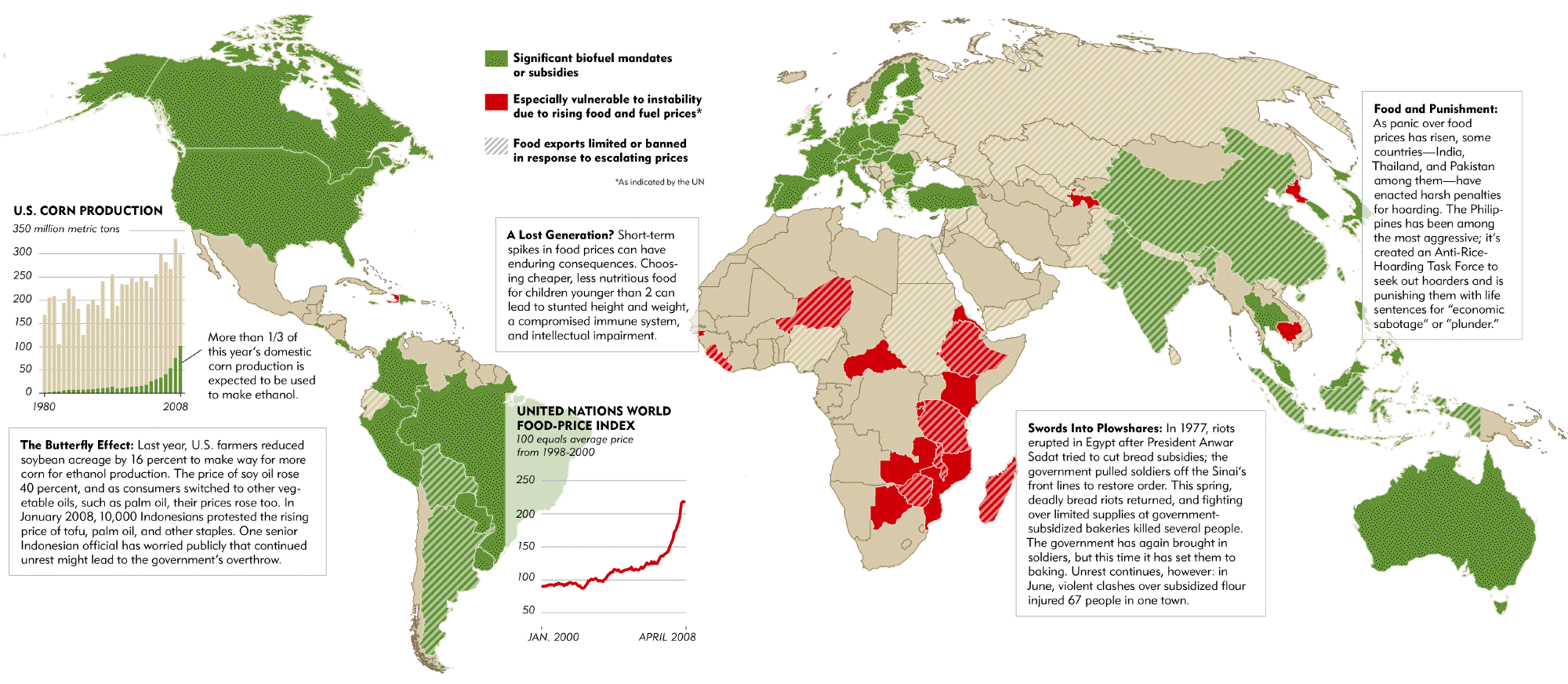
From The Atlantic
Riots and protests over food prices have broken out in 30 countries since 2007. Haiti’s prime minister was tossed out of office in April, largely because of protests over the price of food, and the Malaysian government is looking none too stable for similar reasons. In South Africa, discontent over soaring food and fuel prices provided the spark for violence that killed dozens of illegal immigrants last spring. Even in the United States, wholesalers such as Costco limited the amount of rice each person could buy, unsettling some consumers. It’s possible that the most consequential price spike of 2008 will be in food, not oil.
High food prices, like high oil prices, are partly the result of rising demand by a larger, wealthier world population. But food-supply problems have also contributed to the recent spike in prices, and food has become a source of international tension.
The growth of the global food market has meant more food for billions of people, yet it has also led to a greater concentration of supply. In 2006, the top five oil producers supplied 43 percent of the world’s oil. By comparison, the top five corn producers grew 77 percent of the world’s supply; rice producers, 73 percent; beef and wheat producers, 66 percent each. Because of this concentration, a supply disruption in even one place can ripple through the food market worldwide.
Some disruptions are unavoidable. Last year, for instance, drought in Australia, a major wheat exporter, helped drive up wheat prices by nearly 100 percent. But some disruptions are the result of political decisions. For example, in response to the high wheat prices, India, then the world’s second-largest rice exporter, decided to rely on rice, not wheat, for its public food program—and instituted a ban on most rice exports. Vietnam and Egypt, fearing local rice shortages, quickly followed suit. The result was a seize-up in the global market for rice: prices rose from $333 a ton in 2006 to $963 a ton in May of 2008.
Comments
Comments are closed.