Global Dashboard – Blog covering International affairs and global risks

How to get politicians to take global warming seriously

March 14, 2009 | More on Climate and resource scarcity | 8 comments

Political leaders are driven by a desire for power. They will tend to follow whatever is politically expedient in order to gain power. Right now, it is politically expedient only to make token efforts to try and prevent climate change, without making the electorate fore-go habits to which they have become accustomed.

But leaders are also driven by vanity, and have a powerful desire to be seen well by ‘posterity’ or the ‘history books’. Just look how long Tony Blair spent, while leaving office, in trying to explain his ‘legacy’, or at George W. Bush’s mea culpa last press conference.

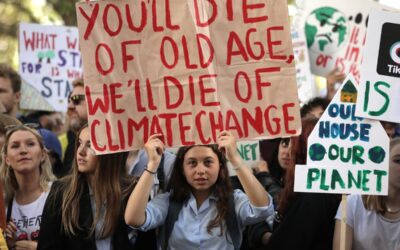
This, it seems to me, is one way political leaders might be persuaded to take dramatic action now on climate change: scientists explain to them very clearly what will happen if the level of CO2 does not fall, they explain very clearly the huge loss of life this will cause,and the actions that need to be taken now if this situation is to be avoided.

And then you tell them that history will judge them. If you consider the infamy in which Adolf Hitler is now held: Hitler was responsible for the deaths of, how many, 40 million people?

That is, unfortunately, a drop in the ocean compared to how many will die in the coming decades if this generation of political leaders fail to do what is necessary.

The terrible suffering of World War II was, on the whole, confined to a generation. If the world warms by 4-6 degrees, the suffering will be felt by many generations, all of whom will look back to the beginning of the 21st century, when political leaders were clearly warned what was going to happen, and what was needed to be done to avoid it, and who failed to do what was necessary.

What this means is, it’s a terrible time to be a politician. Never has the chalice of power been so poisoned. On the one hand, you have to tell an electorate grown complacent with prosperity that they must radically alter their lifestyles and fore-go many activities they now take for granted. As a result, they may very well be voted out of office, or even laughed out of office, for doing do.

On the other hand, if they don’t do this, their names will be mud for decades, even centuries.

They will say ‘we didn’t know’ or ‘it wasn’t politically possible’ or ‘we didn’t have enough time’. But the history books will show that they were told what needed to be done, and they failed to act.

On the other hand, if they do act, if they finally recognise the gravity of the threat facing us, explain to the electorate what needs to be done, and begin leading their electorates through the necessary changes, they will win a place in the history books as great as Churchill, Gandhi, or Martin Luther King .

The line between historic hero or historic catastrophe is very thin right now, and it is not leaders’ response to the credit crunch which will decide their place in the eyes of posterity.

8 comments »


  1. Jules,

    Though I know what you are trying to say and support your message, I find your references to Hitler and the damage he caused as being “easier, and quicker, to recover from” both shrill and unfortunate. If you are trying to persuade people to act against climate change — which I understand to be your noble purpose — then I would suggest avoiding Hitlerian references that will only serve to distract from your point and annoy even supportters like me.

    Daniel


  2. Apologies Daniel, no offense meant to you or others. Ive taken that sentence out.
    Best
    Jules


  3. hmmmmm,why has the climate NOT been getting warmer since 1998?


  4. Actually it’s even more thankless for politicians because if they avert the catastrophic consequences of climate change the general public won’t notice, because life will continue pretty much as it was before. If they are successful, some observers will no doubt argue that climate change wouldn’t have happened anyway. You get a lot more credit for fending off a visible disaster (eg Churchill fighting off the Germans, Luther King fighting off racial repression) than an invisible one. So politicians who are concerned about their legacy might have to be content not with public glory but with their own private knowledge that they’ve done the right thing.


  5. Jules,

    Thanks for this piece. Like Daniel, I feel deeply uncomfortable with the Hitler references.

    Passing over that, though, whilst I hear what you are saying, I think you genuinely have overestimated where our politicians and the electorate are at in terms of understanding of the issues and engagement with the challenge. I’m an elected member of a small British local authority; we have won a few awards from societies who recognise commitment to tackle climate change, and we have an ambitious target for CO2 reduction, which in year 3 starts to encompass our city rather than just the council’s own buildings and activities. Tackling climate change is one of our six priorities, enshrined in corporate plans and LAAs. We have an intelligent and motivated senior officer corps, a dedicated CC unit and a set of elected members many of whom care deeply about the issues and all of whom are pretty aware and engaged (NB – across all parties – too often it is thought to be “Green” politicians that lead this area. In my authority, Liberals and Labour are at the forefront).

    Yet still, tackling CC is in no way central to the operations of my authority. The CC unit are isolated, separate from the mainstream of council life. CC priorities are delivered and celebrated for the money they save. There is little context to the actions we are taking. And frankly, the difference we can make and the impact that action has are so intangible that it is hard to consistently prioritise.

    And, last, but not least, our electorate are nowhere on this. I came into politics to tackle poverty and inequality; I have a full caseload of people on the estate I represent who need help to access barely-adequate housing, benefits and social care. Since being in politics climate change has risen up my agenda, and my understanding is high; for many of us in politics, that battle has been won – we know what needs to be done, or, at least, we know how to find it out. But having an informed set of elected politicians who must seek election from a public who are as yet unpersuaded of the problem, is a recipe for inaction. In a democracy, action far in advance of public attitudes is unsustainable.

    I will continue to consistently vote for and prioritise measures to tackle climate change. But I need people who care about climate change to carry some weight too. Real recognition that people in the UK living on moderate and low incomes have a genuine concern about their standard of living would be a start. Spokespeople that are mainstream would help – rather than these middleclass young women that throw green gunge and stop people going on holiday, waving their dreadlocks and beads at the planes. Not being happy about the carbon reductions a recession will force just as many are losing their jobs would be good. A campaign that sets tackling climate change in the context of preserving the British way of life and helping people leave something for their kids rather than appearing to attack the lifestyles of the majority of British people would be useful.

    Apologies for this comment being a bit locally-particular; this is internationalist space, I know! Keep up the good work – it’s always an education.


  6. Thanks for your comments Antonia,

    Maybe this film will do something to galvanize public opinion:

    http://www.ageofstupid.net/

    Its opening this weekend, we should all go see it.

    Jules


  7. “..without making the electorate fore-go habits to which they have become accustomed.”

    I think a better article could be written about how you get politicians to give up global warming as an issue once they realize how much power they wield while claiming to serve the public interest. The one sentence I referenced from your article tells me you’d like to skip convincing the populace and go straight to making them do what’s best for them. Scary stuff.

    The moment the thick-headed politicians figure out that they can write laws saying:

    * How often I can flush the toilet. And what it costs per flush.
    * Who gets to wash their cars and when.
    * Who can drive what car (exceptions for politicians of course).
    * Where we can go, how fast we can go.
    * How much I should pay in taxes rebuilding the dams for a city built below the water table and filled with people that refused to fix it for themselves and refuse to consider living somewhere else…

    It’s the ultimate end game. The moment they realize they can control essentially every aspect of our lives in an effort to control global warming, and that to fight them is to be labeled the scum of the planet… they win. End game.

    What’s laughable is that global warming can’t be fought locally. Pick any country you like, even the US or China, make them 100% green, and guess what, the rest of them can keep the trend going just fine. The ONLY way you can force the kinds of changes most of you feel-good-better-than-you-hippies (for lack of a better word) feel are necessary is if you gave complete control to a world authority to divvy up the planets resources and control who gets to use em. Do that and the illiterate / unproductive masses of the third world will decide that the developed nations of the world need to suffer their fair share and we can all go back to living in little socialist communes.

    What’s really scary for me, is that I think most of the people behind fighting global warming know you can’t have our current level of civilization and freedom (barring major technological breakthroughs) and they are comfortable with that. Their goal isn’t saving the planet, it’s power. Power to tell others that they are evil, that they know a better way, blah blah blah. They can’t convince, they aren’t interested in technology, they wont acknowledge that all the recycling in the world won’t help a bit with the population growing like it is… they just want to tell you how to live your life.

    I want a healthy planet too, I want happy grandchildren with a place to live and grow. But I’m not willing to be forced to make changes I KNOW can’t solve the problem in an effor to appear nicer, appear hip, and on the green bandwagon. Major technology breakthroughs from the private sector, or population control… those are the two options I see. Personally I’m hoping for technology to save the day, because if not, not only will I have a hippy overlord telling me how to live my life he will also be able to tell me that I can’t have three kids, because all I need are two. And it should be one boy and one girl and they should not wear diapers and they should wear recycled clothing and…..


  8. Thank you for bringing your views to our attention, Jason. Please remain calm and in your habitation unit, and representatives of the Ministry of Adaptation will be round shortly. Britannia forever.

URBEINGRECORDED » Discontinuity & Opportunity in a Hyper-Connected World
Great discussion of complexity and network theory and its relevance to global risks, from Chris Arkenberg

The Emissions Gap Report
This publication aims to assess the following questions: are countries’ pledges of action collectively consistent with and, if implemented, likely to achieve the 2˚C and 1.5˚C temperature goals? If not, how big is the gap between emission levels consistent with these temperature goals and the emissions expected as a result of the pledges?

The Spectator runs false sea-level claims on its cover
These claims rely on misinterpretations of scientific data so grave that even an arts graduate such as Fraser Nelson should have been able to spot them.

Europe’s Insult Diplomacy - Infographic
British Prime Minister David Cameron called French President Nicolas Sarkozy “a hidden dwarf” as part of a joke told to a journalist. German Chancellor Angela Merkel referred to Sarkozy as “Mr. Bean,” while Sarkozy called her “La Boche,” or the Kraut. Spanish Prime Minister José Zapatero is “too pink” because of the high proportion of women in his cabinet, said Italian Prime Minister Silvio Berlusconi. And Berlusconi’s opinion of the euro? “A disaster,” he said, that has “screwed everybody.”

Solar Power's Good News
The White House has challenged the solar industry to produce clean electricity at $1 per watt. It has also set a national goal to achieve 80 percent clean energy use by 2035…The good news is that researchers are racing toward that goal at an impressive rate.

BBC News - Viewpoint: Is the alcohol message all wrong?
"The effects of alcohol on behaviour are determined by cultural rules and norms, not by the chemical actions of ethanol."

Something's Happening Here - NYT - Tom Friedman
When you see spontaneous social protests erupting from Tunisia to Tel Aviv to Wall Street, it’s clear that something is happening globally that needs defining

Foreign Aid Set to Take Hit in U.S. Budget Crisis - NYTimes.com
America’s budget crisis at home is forcing the first significant cuts in overseas aid in nearly two decades

Israel - Adrift at Sea Alone - NYTimes.com
Tom Friedman bemoans "the most diplomatically inept and strategically incompetent government in Israel’s history"

Eurozone: A nightmare scenario - FT.com
How it could all go pear-shaped - your cut-out-and-keep flow chart guide

Sharp fall in poor countries' dependency on foreign aid says ActionAid report
Aid dependency among 54 of the world’s poorest countries has declined by a third over the last decade, according to a new report from ActionAid.

World environment programs in budget crosshairs | Reuters
Global conservation programs are prime targets for budget-cutting: they sit at the crossroads of two things Americans dislike spending money on, aid and environment.

Attack of the Superweed - BusinessWeek
widespread use of Roundup has led to the evolution of far-tougher-to-eradicate strains of weeds

Jon Stewart Says Rick Perry Is the Candidate Republicans Want, and Deserve
Laugh out loud funny

Global reach is the prize at Busan - Resources - Overseas Development Institute (ODI)
Jonathan Glennie and Andrew Rogerson on what you need to know ahead of the big aid effectiveness summit

When Bloggers Don’t Follow the Script, to ConAgra’s Chagrin - NYTimes.com
Ha ha ha - epic PR #fail

Obama backs down on tighter smog regulations | World news | The Guardian
In case you missed it. Yes we can...

Wikileaked cable: executions of children by US forces in Iraq
Wikileaked cable with harrowing reports of  US forces handcuffing and then killing 10 people - including children aged 5 years, 3 years and 5 months.

BBC News - Tests show fastest way to board passenger planes
The way airlines board planes turns out to be the least efficient

New sources of aid: Charity begins abroad | The Economist
"The establishment donors’ aid monopoly is finished."

Who Doomed Sarah Palin's Presidential Dream? | TPMDC
Where did it all go wrong for Sarah?

The Intergenerational Foundation
"We believe that each generation should pay its own way, which is not happening at present."

Should we have a land value tax? - MoneyWeek
Discussion of pros and cons for the UK, following an article by OECD's chief economist in Prospect

Toward a Post-2015 Development Paradigm | Centre for International Governance Innovation | Centre pour l'innovation dans la gouvernance internationale
12 new development goals are proposed to replace the MDGs from 2015 - the outcome of an IFRC / CIGI conference at Bellagio

China Gets (Needlessly) Defensive Over Famine in Africa - China Real Time Report - WSJ
Germany's Africa policy coordinator causes dispute by singling out Chinese landgrabs as a culprit in the Horn of Africa famine

Latin America: A toxic trade - FT.com
Must read broadside against probably the most stupid and avoidable public policy screw-up in recent memory: the war on drugs

The intellectual collapse of left and right - FT.com
Michael Lind on how the economic inclusion narratives of centre left and centre right are simultaneously imploding - must read

Julia Gillard back to rock-bottom: Newspoll | The Australian
Bad news for supporters of green taxes and decisive action on climate change

Oxfam’s looking for a new Head of Research
A plum role is up for grabs

The global crisis of institutional legitimacy | Felix Salmon
"Our hearts want government to come through and save the economy. But our heads know that it’s not going to happen."

UBS' George Magnus On Marxist Existential Crises And The "Convulsions Of A Political Economy" | ZeroHedge
Not every day you see investment banks publishing detailed analysis of Karl Marx

Food Prices Could Hit Tipping Point for Global Unrest | Wired Science | Wired.com
New quant research on thresholds over which high food prices cause riots

Ambassador Locke Picks Up His Own Coffee, Gains 'Hero' Status Among Chinese : The Two-Way : NPR
Some pictures of the brand new U.S. ambassador to China are causing quite a stir.

Jon Stewart | Ron Paul | Michele Bachmann | Mediaite
Jon Stewart breaks down the state of play on the Republican Presidential race

The Bucky-Gandhi Design Institution › When?
Some properly out of the box thinking from Vinay Gupta. Must-read.

England’s riots: If the UK were a fragile state… | Dan Smith's blog
By the head of a leading peacebuilding NGO

Post-Traumatic Stress Disorder From 9/11 Still Haunts - NYTimes.com
At least 10,000 New Yorkers still have PTSD from 9/11

The unlikely social network fuelling the Tottenham riots « The Urban Mashup Blog
Not Twitter, not Facebook but.... Blackberry Messenger

Mapping world food price volatility | Nourishing the Planet
Clickable map of global food price hotspots

Will the 2012 Earth Summit be a flop? > From Poverty to Power
Great summary of the state of play on Rio 2012 from Oxfam's Sarah Best

Articles & Publications
Sustainable Development Goals – a useful outcome from Rio+20?

Recent months have seen increasing interest in the idea that Rio+20 could be the launch pad for a new set of ‘Sustainable Development Goals’ (SDGs).  But what would SDGs cover, what would a process to define and then implement them look like, and what would some of the key political challenges be? This short briefing [...]

Creating Consensus on a post-2015 framework for development

Any global framework for development which is agreed after 2015 will be a political deal between states. This paper looks at recent trends in policy and politics in emerging economies and traditional donors to assess where a consenus might lie. It suggests some principles for a post-2015 agreement which emerge from recent policy developments

A post-2015 Global Development Agreement: why, who what?

Paper from ODI and UNDP, authored by Claire Melamed and Andy Sumner, summarising the evidence on the impact of the MDGs, and looking at current trends in poverty and in global governance that will affect the shape and the scope of any future agreement on global development.

Resource Scarcity, Fair Shares and Development

Why resource scarcity will be a game changer for global justice agendas, and what aid donors, NGOs and other development opinion formers need to do about it. WWF / Oxfam report by Alex Evans.

Making Rio 2012 Work: Setting the stage for global economic, social and ecological renewal

The Rio 2012 sustainable development summit is at risk of being the latest in a long line of damp squibs on environmental multilateralism – but could still make real progress, if it focuses on greening growth and building resilience to shocks and stresses, and above all faces up to the issues of fair shares that arise in a world of limits.

Governance for a Resilient Food System

How national and international governance systems need to be reconfigured to meet the challenges of food security in a world of tighter supply and demand balances and increasing volatility. Report for Oxfam’s new Grow campaign by Alex Evans. (May 2011)

Running out of everything: how scarcity drives crisis in Pakistan

Article on scarcity of resources in Pakistan and what it means for the country.

Economics for a world with limits

Text of speech by Alex Evans to Institute for New Economic Thinking annual conference at Bretton Woods; the YouTube video is here. (April 2011) Download Speech

Unscrambling the price spike

Article published on China Dialogue on reasons for the new food price spike, including potential implications of the current drought in China. (February 2011) Download Article

2020 Development Futures

Eight critical uncertainties for development over the next decade, and ten recommendations for what ActionAid – who commissioned this report – should do to prepare for them

American Foreign Policy in an Age of Uncertainty

Article published in World Politics Review on current American foreign policy

The World in 2020 – Geopolitical and Trends Analysis

Report asking how organisations can prosper in what will be a turbulent period for world order

Globalization and Scarcity

Center on International Cooperation report on what forms of multilateral cooperation are needed to manage scarcity of resources

Resource Scarcity, Climate Change and the Risk of Violent Conflict

Background paper on whether resource scarcity and climate change will cause increased violent conflict

Organizing for Influence: UK Foreign Policy in an Age of Uncertainty

Chatham House report on how the UK’s new coalition government should upgrade and reform the way Britain conducts foreign policy

The Long Crisis Seminar

Introductory remarks by David Steven at a Brookings Institution seminar on risk and resilience in the global system (March 2010)

Stop Betting the House talk

Talk given by David Steven at Gresham College on risk and resilience in the UK housing market, as part of a Long Finance Roundtable meeting (March 2010)

Time to Stop Betting the House: a response to the FSA

Report by David Steven in response to the FSA’s Mortgage Market Review

Confronting the Long Crisis of Globalization: Risk, Resilience and International Order

Brookings Institution report by Alex Evans, Bruce Jones and David Steven on how globalisation could fail – and how it could be made more resilient. Published to coincide with the 40th anniversary World Economic Forum in Davos.

Hitting Reboot – where next for climate after Copenhagen

Report by Alex Evans and David Steven analysing the post-Copenhagen context on climate change, including a proposed 12 point action plan. Written for the Brookings Institution / NYU Center on International Cooperation Managing Global Insecurity programme.

Climate Change and Hunger: Responding to the challenge

World Food Programme report on the state of the science on what climate change means for hunger, plus policy recommendations. Authored by IPCC Impacts Chair Martin Parry with Mark Rosengrant, Tim Wheeler and Global Dashboard’s Alex Evans (December 2009)

Scarcity, security and institutional reform

Presentation by Alex Evans to a seminar organised for the UN Department of Political Affairs by the Geneva Centre for Security Policy (August 2009)

The Resilience Doctrine

Article on risk and resilience by Alex Evans and David Steven – part of a special in World Politics Review on risk and resilience in a globalized age (July 2009)

An Institutional Architecture for Climate Change

Report by Alex Evans and David Steven exploring the future international institutional requirements for managing climate change, and including three scenarios for climate institutions between now and 2030. Commissioned by the UK Department for International Development. (May 2009)

Risks and Resilience in the New Global Era

Article by Alex Evans and David Steven exploring resilience as a political agenda – part of a special edition of Renewal on the transformation of foreign policy (February 2009)

A Tale of Two Cities

Climate and cities think piece, co-authored by David Steven and the British Council’s Peter Upton (29 January 2009)

The Feeding of the Nine Billion

Chatham House pamphlet by Alex Evans on how scarcity issues will shape the outlook for global food production, and the actions that policymakers need to take at the international level and in developing countries to ensure food security in the 21st century

2009 – A Year for International Reform

Paper by David Steven, presented to “Reforming International Institutions – Meeting the Challenges of the 21st Century,” a conference organized by the United Nations University and the British Embassy in Tokyo (Jan 2009).

Food prices: what next?

Speech by Alex Evans at the Tomorrow Network (25 November 2008)

A Bretton Woods II Worthy of the Name

Paper by Alex Evans and David Steven on financial reform and wider multilateralism, published ahead of the G20 ‘Bretton Woods II’ Summit (November 2008).

The Future of Resilience

Speech by David Steven to RUSI Conference on UK Resilience (8 October 2008)

Towards a Theory of Influence

Chapter by Alex Evans and David Steven in the Foreign & Commonwealth Office publication, ‘Engagement: public diplomacy in a globalised world’ (July 2008). Download Chapter

Multilateralism for an Age of Scarcity

Draft report by Alex Evans exploring multilateral system reforms needed in order to manage resource scarcity issues more effectively. The final version will be published in early 2010 (July 2008)

Scarcity issues and conflict in Africa

Speech by Alex Evans at UK Parliament (8 July 2008)

A Low Carbon World – Pathways to a Global Deal

Speech by David Steven at the UNU G8 Symposium (4 July 2008)

Climate, scarcity and multilateralism

Speech by Alex Evans to United Nations Association UK (7 June 2008)

The new public diplomacy and Afghanistan

Speech by David Steven to the UK Defence Academy’s Advanced Research and Assessment Group seminar on Strategic Communications, Public Diplomacy and Afghanistan (4 June 2008).

Technology and Public Diplomacy

Speech by David Steven to the University of Westminster Symposium on Transformational Public Diplomacy (30 April 2008).

Rising Food Prices: Drivers and Implications for Development

Briefing paper by Alex Evans, published through Chatham House’s food programme (April 2008).

Looking Forward: how do we build resilience?

Speech by David Steven to RUSI Conference on Critical National Infrastructure (16 April 2008).

Shooting the Rapids: multilateralism and global risks

Paper by Alex Evans and David Steven, commissioned by Gordon Brown and presented to heads of state at the Progressive Governance Summit (April 2008).

Beyond a Zero-Sum Game on Climate Change

Chapter by Alex Evans and David Steven, as part of the British Council’s Transatlantic Network 2020 book ‘Talking Trans-Atlantic’ (March 2008).

From Bali to Copenhagen: towards an endgame for global climate policy?

Article by Alex Evans for the Environmental Policy & Law Journal (January 2008).

Climate Change: The State of the Debate

Report by Alex Evans and David Steven, written for the London Accord (December 2007).

The Post-Kyoto Bidding War: bringing developing countries into the fold

New paper by Alex Evans on climate policy after 2012 from the Center on International Cooperation (October 2007).

Alternative CSR: the Foreign & Commonwealth Office

Chapter on the FCO from Manchester University Press’s Alternative Comprehensive Spending Review, by David Steven (September 2007).

Fixing the UK’s Foreign Policy Apparatus: A Memo to Gordon Brown

Note by Alex Evans and David Steven about how to restructure the UK’s foreign policy system in order to manage trans-boundary global risks better (April 2007).

Evaluation and the New Public Diplomacy

Talk given by David Steven at the Wilton Park conference: The Future of Public Diplomacy. Focuses on strategies to drive public diplomacy to the heart of the foreign policy armoury (March 2007).

Articles and Publications

YouTube Preview Image

Gabrielle Giffords to step down | 2 Comments

YouTube Preview Image

Oh to be in the president of Turkmenistan’s entourage… | 1 Comment

YouTube Preview Image

David Carr And Danah Boyd Share Insights | Comments Off

YouTube Preview Image

Edgar Mitchell on the Overview Effect | 1 Comment

YouTube Preview Image

Presidential debate fail | 2 Comments

More What we're watching

Key Posts
Cheap food: bad. Expensive food: terrible. Why the FAO’s glass is always empty8

It’s interesting to look back a few years – to when the world was worried that food was too cheap, not too expensive. In 2004, the UN Food and Agricultural Organization looked back on a long bear market for food: forty years in which real prices of agricultural commodities had fallen 2% per year, or [...]

How many people are hungry?3

The good news: poverty is in retreat. The bad news: hunger isn’t.  That’s the headline finding for the first Millennium Development Goal , which aims to halve the proportion of people living on less than $1.25 a day and the proportion of people living in hunger between 1990 and 2015. Great strides have been made [...]

“Freeing the entire human race from want”2

The MDGs are so over Having just been rude about one World Bank report, here’s a positive review of another – the Global Monitoring Report 2011, which the Bank produces jointly with the IMF. The GMR updates progress against the Millennium Development Goals – targets that were set as the culmination of a push throughout [...]

21 years ahead of its time5

A 1989 article on ‘the global teenager’ in Whole Earth Review was way ahead of its time in identifying the crux of what today’s youth bulge means for global change

Is it time for Sustainable Development Goals?5

The pros and cons of a new global set of Sustainable Development Goals (SDGs) – and how they might work in practice

The one book you must read over the summer9

Mark Lynas’s new book The God Species is a must-read for environmentalists

Fair shares in a world of limits: the new front line for development-

Thoughts after from a joint WWF / Oxfam seminar on resource scarcity, fair shares and development.

What the ‘powershift’ narrative overlooks on US-China relations-

The ‘powershift’ narrative about US-China relations obscures how much they have in common: unsustainable growth paths, shaky financial sectors, political sclerosis, massive inequality, reliance on imported resources and above all their status as the two principal obstacles to collective action on shared global risks.