Keyes on Obama: an abomination
[youtube]http://www.youtube.com/watch?v=lqkMfToY9Pk[/youtube]

[youtube]http://www.youtube.com/watch?v=lqkMfToY9Pk[/youtube]
In the Times today there is a story about one of the greatest British counter-insurgents, Emma Sky. Military commanders describe the Arabic-speaking, British Council official as a modern-day Gertrude Stein.
Now working for General Ray Odierno, the diminutive, Left-wing Sky initially got to know the 6 foot 5 inches warrior when they both worked in Tikrit immediately after the 2003 invasion. In between her stins in Iraq, she served as British General David Richard’s adviser in Kabul. Since about 2007 –- when Sky took her current post as a key aide to the MNF-I commander — no British official, including successive British ambassadors in Baghdad, has been as influential on US counter-insurgency policy or, indeed, on US Iraq policy.
Last year, Sky published an article for RUSI called Moving Beyond Counter-Insurgency Doctrine, a must-read for counter-insurgency devotees and anyone who wants to understand US Iraq policy medio-2007.
Whenever she finishes her assignment in Iraq, the British government would do well to immediately (create and) offer a post as the Defence Secretary’s Special Adviser for Counter-Insurgency, from where she will be able to bring many of the lessons from US operations in Iraq into the British military and bureaucracy — something that is sorely needed.
One thing all serious experts on disasters and resilience agree on is the need to keep your morale up while everything you thought you could rely on is crumbling around you.
Brian Clegg’s Global Warming Survival Kit , for instance, has checklists to see if your outlook is flagging under the pressure. “Everything seems pointless” – check! “Always feeling sad, or simply blank” – check! “Feeling worthless and without value” – check!
Fortunately, help is at hand. The final chapter of his book offers a range of techniques for keeping chirpy: from ‘relaxation by breathing’ (Amanda Ripley‘s keen on that one too), making music, or – best of all – simply playing games. As Brian so rightly observes,
A stash of games is very useful if you have to entertain yourselves, and they will make good bartering objects too.
Well, here at Global Dashboard we know good advice when we see it – and of course it also goes without saying that we’re dedicated to helping our readers through these turbulent times as well. So we’re proud to unveil our own special game: Network Disruption Bingo.
During an exhaustive mapping process undertaken over a period of nearly 45 minutes, we’ve identified the key networks we all depend on but rarely stop to consider. Then (here’s the science part – concentrate), we’ve allocated points to each one depending on how bad it would be if it crashed, and put them on a special scorecard.
Print it out, and keep it safe for the dark nights ahead. You never know, you may be able to barter it for something useful.
Irrational exuberance is alive and well. Spawned by Obama’s candidature and sustained despite his recent setbacks, many people still seem to believe that all manner of foreign policy challenges can be overcome.
One of the most interesting parts of Barack Obama’s rise to power was the frenzied enthusiasm he garnered along the way. Even the mob-fearing Germans turned out in their thousands to hear him deliver unwelcome policy missives (“The Afghan people need our troops and your troops; our support and your support to defeat the Taliban and al Qaeda”). At times, Obama’s presidential candidacy verged on a cult of personality.
There were a few skeptics, to be sure. But most were curmudgeonly analysts or political adversaries. Few of the change-deniers seemed, well, seemed to be quite with it. In the main, people sang “Yes We Can”, swayed to Obama’s rhetoric and believed with all their hearts.
Little more than a month after his election, the sheen has not quite come off Obama, but his administration has taken a few direct hits. Tom Daschle, a former senator, was nominated as health secretary. As with two other Obama nominees, it subsequently emerged that he had failed to pay all his taxes, and he was forced to withdraw his name from consideration. The new treasury secretary, Timothy Geithner, has proved les adept at handling the economy that hoped. His first press conference saw markets tumble.
Despite these set-backs, there is no shortage of exuberance. Even hard-bitten analysts believe that in 2009-2010, world leaders can agree on a new NPT regime, establish a follow-on to the Bretton Woods systems, re-start the Doha round of multilateral trade talks and hammer our a climate deal in Copenhagen. Some even think that the entire multilateral system can be re-ordered while the US deals with NATO’s Afghan mission, Iran’s nuclear programme, Pakistan’s potential collapse, Russia’s rise, and the threat posed by a festering Middle East.
However, the truth is this agenda is probably too broad for one president, even two terms and certainly for the many stakeholders that now have to be brought into any of the global deals. The multilateral system will not be revamped, but remain a mosaic. If we are lucky, the economic crisis will be contained, but do not expect a new kind of managed globalization. George Soros has called for a eurozone government bond market, but it is hard to see European governments accepting such an overtly federalist move (which, incidentally, they rejected when the ECB was originally set up).
As to the many structural issues –- the NPT regime, climate change, the trade talks –- one or two may be solved, but certainly not all and certainly not in the next two years. Politically, trade-offs will have to be made between Iranian help in Afghanistan or an Iranian nuclear bomb. Between European unity or European energy security. Perhaps even between our economic well-being and poverty-alleviation elsewhere.
Like in the NICE decade — non-inflationary constant expansion — in which people forgot economic gravity, so people now seem to have taken leave of their foreign policy senses.
But a new world awaits. It may not look much different than the 19th century: power politics, “concert of Europe”-style diplomacy, inequality of states, spheres of influence, and interests, not values, as the driving forces behind international politics.
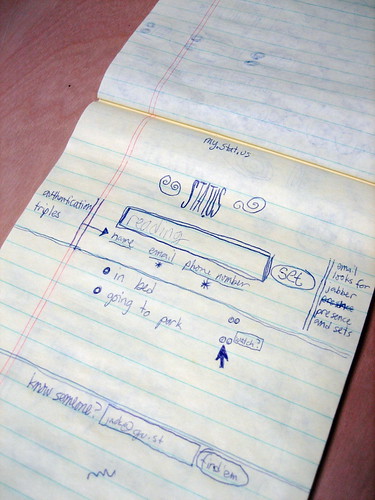
Courtesy Jack Dorsey
Jack Dorsey has been talking to the LA Times about his early sketch (from 2000) for STATUS, a service that would eventually be launched as Twitter.
What’s interesting is that urban resilience was a core part of Twitter’s inspiration:
Twitter has been my life’s work in many senses. It started with a fascination with cities and how they work, and what’s going on in them right now. That led me to the only thing that was tractable in discovering that, which was bicycle messengers and truck couriers roaming about, delivering packages.
That allowed me to create this visualization — to create software that allowed me to see how this was all moving in a city. Then we started adding in the next element, which are taxi cabs. Now we have another entity roaming about the metropolis, reporting where it is and what work it has, going over GPS and CB radio or cellphone. And then you get to the emergency services: ambulances, firetrucks and police — and suddenly you have have this very rich sense of what’s happening right now in the city.
But it’s missing the public. It’s missing normal people. And that’s where Twitter came in.