Climate – what’s the worst that can happen
[youtube]http://www.youtube.com/watch?v=mF_anaVcCXg[/youtube]

[youtube]http://www.youtube.com/watch?v=mF_anaVcCXg[/youtube]
About 10-20%, if you believe the bond markets. Spreads on the debt of southern European sovereigns like Greece, Spain, Portugal and Italy have now widened to record levels over their Northern compatriots’ bonds. These countries all lost their AAA bond rating from Standard & Poor’s earlier this month, which means S&P’s thinks there is a chance, albeit a slim one, that these countries default on their debt.
Some think this could presage the eventual collapse of the eurozone, though others think the rating agencies are getting it wrong again, and see this as a good buying opportunity, such as money managers BlackRock.
“You have got to ask yourself at what point this becomes ridiculous,” Scott Thiel, head of European fixed income in London at BlackRock, which manages $1.3 trillion, said in an interview Jan. 23. “That’s too high if you step back and take a deep breath. We’ve begun to add back exposure” of these bonds.
An interesting question is whether the US could lose its AAA rating. Seeing as the entire credit markets are priced over US Treasuries, this would be a colossal disrupture to bond markets – sort of like the clock at Greenwich stopping.
OK, it’s only NYC East Village Gastropub “EU” – but it makes for a snappy photo:

What went wrong? The original review from New York magazine rings a bell:
The menu at E.U. is a schizophrenic mélange of received trends and styles, centering on European comfort foods. You can get German sausages squeezed into a bun made of fresh pretzel dough, and two styles of Euro burger: the German, topped with liverwurst and bacon, and the Cheddar-and-gravy-smothered English (mine was overdone).
Apply your own similes and metaphors as required.
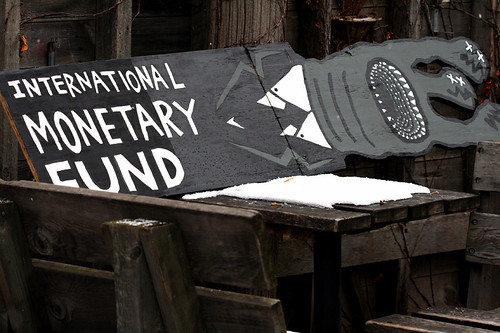
Courtesy Flickr user massdistraction
The IMF today predicted a grim economic outlook for 2009, with some green shoots in 2010.
The news is especially grim for the UK and Eurozone countries, with a 2.8% and 2% fall in output in 2009 and barely any growth in 2010. The US is predicted to do quite a lot better – a 1.6% fall this year, but 1.6% of growth next. That should cue a pleasant new wave of American triumphalism.
China floats through the crisis more or less unscathed. Growth slips to 6.7% in 2009, but bounces back to 8% in 2010. India does a little worse, Brazil suffers pretty badly, while the Mexican economy really tanks.
But I really don’t know why I even bothered to read the stats. Nine months ago at the Progressive Governance Summit, Dominique Strauss-Kahn told everyone that Europe and the US would experience a slowdown, but not a loss of growth (with the European economy expected to outperform the American one).
Even since it last ran its models in November (just three months ago!), the IMF has knocked 1.7 percentage points off world growth, and a staggering 6 points from its prediction for what were once known as the Asian tigers.
The IMF itself is forced to admit that “the uncertainty surrounding the outlook is unusually large.” Doesn’t that translate as “our models weren’t built for these crazy conditions, but we’ll run them anyway and PR them heavily to the 1000 or so media outlets that’ll reprint our speculation as fact”?
Or am I missing something here?
Alex has got a good deal of media attention for his excellent new Chatham House report on future of food crises but the Daily Telegraph got the real scoop – by making up a scare story about the death of the Sunday Roast:
Researchers at Chatham House, a think-tank, found that a recent fall in the price of butter, milk and bread was likely to be only a “temporary reprieve”.
The price hikes would hit the price of beef, pork and lamb harder because they are reared on proportionately more grain than “white meat” like chicken.
Alex Evans, the report’s author, said the likely effect would be to make Britons less reliant on beef as a core part of the nation’s diet.
“It will become more expensive,” said Mr Evans. “We are not saying people won’t be able to have a Sunday roast but we will be eating less red meat in future.”
Now, there are some kill-joys who might point out that Alex’s report doesn’t actually mention the Sunday Roast once, but Global Dashboard has an established track-record of commentary in defense of fine British food: check out Evans and Gowan on Bubble, Squeak and eels last July. But the fact that pork prices are set to sky-rocket may explain an American internet phenomenon noted by the NYT today: a BBQ recipe going viral.
This recipe is the Bacon Explosion, modestly called by its inventors “the BBQ Sausage Recipe of all Recipes.” The instructions for constructing this massive torpedo-shaped amalgamation of two pounds of bacon woven through and around two pounds of sausage and slathered in barbecue sauce first appeared last month on the Web site of a team of Kansas City competition barbecuers. They say a diverse collection of well over 16,000 Web sites have linked to the recipe, celebrating, or sometimes scolding, its excessiveness. A fresh audience could be ready to discover it on Super Bowl Sunday.
Where once homegrown recipes were disseminated in Ann Landers columns or Junior League cookbooks, new media have changed — and greatly accelerated — the path to popularity. Few recipes have cruised down this path as fast or as far as the Bacon Explosion, and this turns out to be no accident. One of its inventors works as an Internet marketer, and had a sophisticated understanding of how the latest tools of promotion could be applied to a four-pound roll of pork.
Leaving aside the new media aspect of all this, I’d argue that Americans are wisely stuffing down bacon and sausage before the prices head back up. If you want to make your own Bacon Explosion, the recipe’s here. My own urge to start layering the bacon wrapping was reduced by the discovery that the outcome looks like, well, you know…

For those more interested in making a quick buck than a Bacon Copralite (google it yourself), switch over to Porkworld, Latin America’s leading swine-trade website, which naturally features quotations from one Alex Evans…