Since I’ve already renounced any and all claims to knowing anything about US politics, I’m happily unburdened by any pressure to predict the shape of an Obama cabinet should he win. But what are the experts of the commentariat predicting?
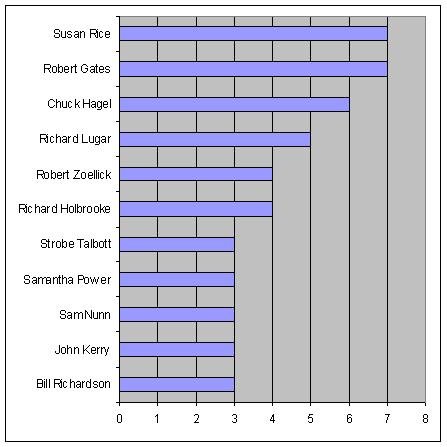
I spent some time this afternoon ranging far and wide over t’internet in search of speculation on who’s in line for the key foreign policy-related posts in an Obama Administration (Secretary of State, Secretary of Defense, Director of National Intelligence, National Security Adviser and Ambassador to the United Nations) – using a thoroughly unscientific but broadly mainstream selection of 20 newspapers, magazines, foreign policy experts and foreign policy bloggers.
As I surveyed this glittering array of insight, these were the names that came up at least three times each:
Why yes, since you ask: four out of the top five names are Republicans. A ‘government of all the talents’, as you might say.
(Gideon Rachman goes further than most in applying this admirable principle: he’s gleefully suggesting Sarah Palin for Ambassador to Russia. As he observes, “The governor’s taste for hunting, plain-spoken talk, and foxy boots—not to mention long years of staring at Russia from Alaska—ensure a special relationship with Putin.”)
Paul Krugman frets that we are about to witness the mother of all currency crises in emerging markets, and I am afraid that he is right. As I wrote in my previous post, the financial crisis in the developing world has just started and there are indications that it will get a lot, a lot worse. What is different with this phase of the crisis is that it cannot be addressed by governments in the affected countries issuing their own fiscal guarantees and domestic currency. These countries need external lines of credit, and they need it fast before the scale of the problem becomes truly unmanageable.
The solution is clear. The IMF, possibly along with central banks of the G7, has to act as a global lender of last resort to emerging markets. These countries have to have ample access to liquidity in reserve currencies–quickly and with few strings attached–for them to be able to fend off what may otherwise become a historic rout of their currencies. And China should join in: it should make a portion of its near-$2 trillion of reserves available in support of this global enlargement of credit lines.
Emerging markets have every right to say that they are being swept under by a crisis that is not their own doing. But the real reason the rest of the world needs to move on this front is naked self-interest. Combine a deep recession in the advanced countries with an uncontrolled depreciation of emerging-market currencies, and the pressure to erect trade barriers in the U.S. and Europe will be impossible to withstand. A vicious cycle of unemployment and protectionism feeding on each other a la 1930s could transform the deep recession everyone is already expecting into a second great depression. It can get worse…
And with this bit of good news just in, Dominique Strauss-Kahn should have no distractions to prevent him from focusing on this most urgent task. There are some reports that the IMF is moving in this direction. I have a feeling that this will be the make-it-or-break-it week for emerging markets. I hope the IMF will make an announcement in time to make a difference.
There’s an interesting interview with Chinese premier Wen Jiabao by Fareed Jakaria on the CNN website. Wen again talks about his love of Marcus Aurelius’ Meditations, and how it plays a role in his political philosophy.
This philosophy, as far as I can tell, is one of Stoic resilience in the face of catastrophe, such as the earthquake that hit China in May, when Wen immediately flew out and took command of the recovery situation.
He spoke at greater length in New York in September:
I had a background in geological studies and I am familiar with an important theory in the study of the history of geological periods: that is the catastrophic theory. In the past six years since I took office as the Chinese Premier, it is fair to say that we have encountered numerous disasters and difficulties.
From the outbreak of the SARS epidemic, to the sleet- and snow-storm that hit southern China, and then to the massive earthquake that devastated Wenchuan, Sichuan province, and from the accidents in the coal mines to the food safety incident that occurred recently, all this has given us a very informative experience, and we have learned new things from overcoming these difficulties. As I always say: what a nation loses in a disaster will always be compensated by progress later on.
As you may know, I very much enjoy reading Meditations, a classical work written by Marcus Aurelius. In this classical work I once read: as for so-called great men, where are they now? They are all gone. Some of them may be enough to form a story and some others may not even be enough to form half a story. So I would rather prefer leaving some spiritual legacy behind, mainly as the following two points:
Number one, in the wake of a disaster, we should not yield to the difficulties, rather we should have the courage to face up to the difficulties head-on and we should have the courage to lead our people to surmount the difficulties. To do that, we need to have a firm stand; we need to have courage and confidence.
Number two, as far as a government is concerned, a government should be responsible for its people, should be dedicated to serving the people, and should be marked by dedication and its clean and honest behavior. Except for these, a government should not have any privilege whatsoever. All the power belongs to the people and all the power should be used for the people.
As an old Chinese saying goes: a spring silkworm keeps producing silk until it dies and a candle keeps giving light until it burns into ashes. I am already sixty-seven years old, and I will dedicate the rest of my power and energy entirely to the Chinese nation and to the Chinese people and I hope that when I leave this world people will remember that I, as the Premier, have actually followed the two principles that I mentioned before, and that way I will also rest in peace.”
Grandpa Wen’s love of Marcus Aurelius has done wonders for the old Stoic’s reputation in China. The Meditations has been in the top ten bestseller list there for several months.
We are now officially beginning some sort of post-credit crunch global governance feeding frenzy. We now have the following to look forward to:
– The report of a new High Level Commission on modernisation of the World Bank, chaired by former President of Mexico Ernesto Zedillo;
– A UN General Assembly task force on the global financial system, chaired by Joseph Stiglitz (composition and terms of reference to be announced on 30 October);
– An EU summit on the financial crisis and reform of global financial institutions on 7 November, to prepare for…
– A G20 summit on international financial institution reform in Washington DC on 15 November (though no-one seems to have told the G20 secretariat);
– A UN Financing for Development summit from 29 November to 2 December – it’s been in preparation since last year, but Ban Ki-moon has now suggested turning it into a UN summit on the financial crisis, in NYC rather than Doha as planned (Ban says:
“I strongly believe that holding the summit at the United Nations, the symbol of multilateralism, will lend universal legitimacy to this endeavour and demonstrate a collective will to face this serious global challenge…”)
I make no claim to this being a comprehensive list (and will add to it as I find more baubles to hang on the tree). But it all invites the question: how much is really going to be achieved through all this pannelling and summitry? As Eurodad, the civil society network on debt relief, notes on its website:
Several meetings that Eurodad staff have had in recent days reveal that senior European policy makers have few precise reform proposals for this summit meeting and have not started negotiating a common EU position. Indeed smaller European countries are unhappy that they will be excluded from the 15 November meeting. The summit – with its extravagant “Bretton Woods II” billing – may reveal a very dangerous gap between expectations and delivery,
Too right. Over the summer, there were no fewer than three summits (FAO; G8: WTO) that claimed in advance that they were riding to the rescue on food prices, and which then failed to deliver anything interesting. Now it looks like we’re about to do the same on the credit crunch…
Update: Eurodad have produced a helpful FAQ on the ‘Bretton Woods II’ summit – download it here. Thanks to Alex Wilks.
Update 2: David and I have published a briefing paper on the Summit.