Global Dashboard

« Governor Palin, you’re no Dan Quayle | Home | Brown’s reshuffle »

Friday’s mid morning map

October 3, 2008 | by Charlie Edwards | More on Climate and resource scarcity, Economics and development, Global system, Off topic | No comments

Just spotted the following map in The Atlantic .
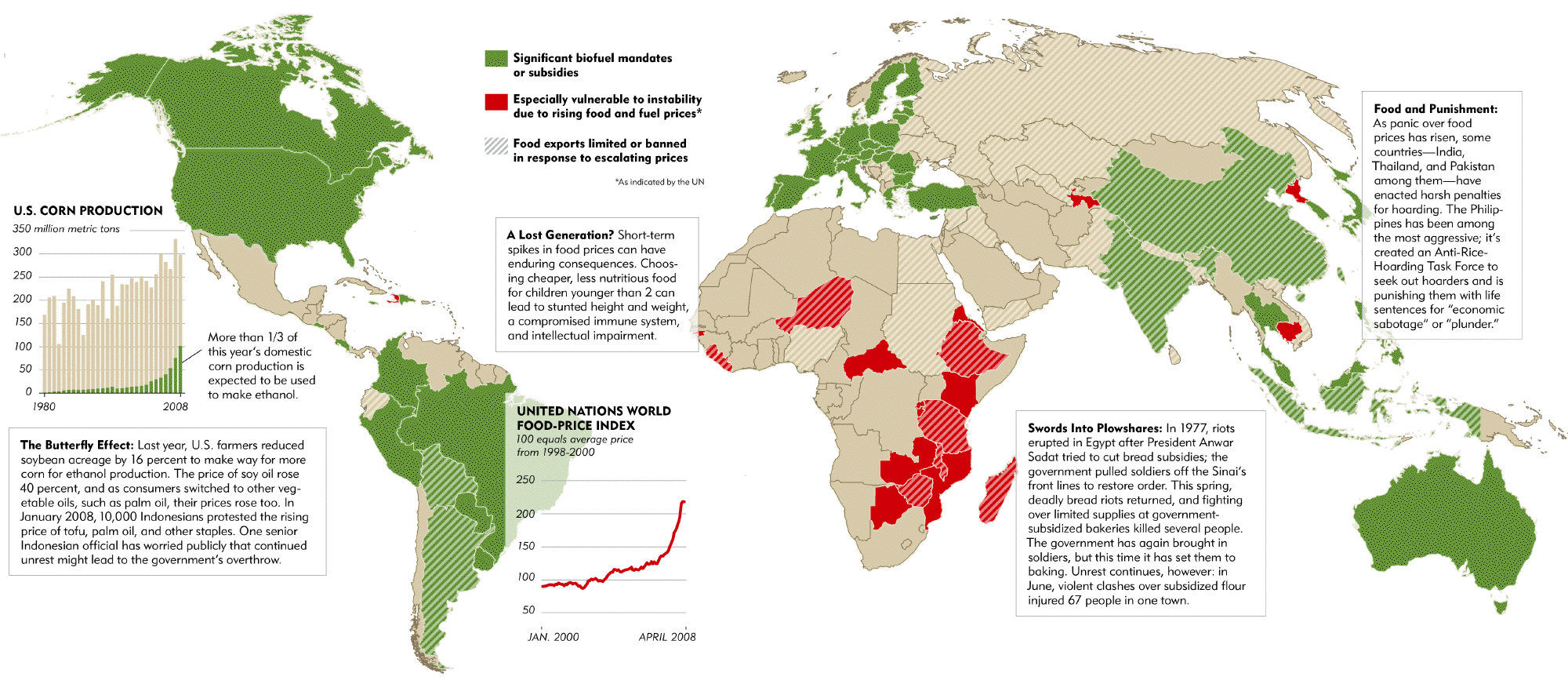
From The Atlantic

Riots and protests over food prices have broken out in 30 countries since 2007. Haiti’s prime minister was tossed out of office in April, largely because of protests over the price of food, and the Malaysian government is looking none too stable for similar reasons. In South Africa, discontent over soaring food and fuel prices provided the spark for violence that killed dozens of illegal immigrants last spring. Even in the United States, wholesalers such as Costco limited the amount of rice each person could buy, unsettling some consumers. It’s possible that the most consequential price spike of 2008 will be in food, not oil.

High food prices, like high oil prices, are partly the result of rising demand by a larger, wealthier world population. But food-supply problems have also contributed to the recent spike in prices, and food has become a source of international tension.

The growth of the global food market has meant more food for billions of people, yet it has also led to a greater concentration of supply. In 2006, the top five oil producers supplied 43 percent of the world’s oil. By comparison, the top five corn producers grew 77 percent of the world’s supply; rice producers, 73 percent; beef and wheat producers, 66 percent each. Because of this concentration, a supply disruption in even one place can ripple through the food market worldwide.

Some disruptions are unavoidable. Last year, for instance, drought in Australia, a major wheat exporter, helped drive up wheat prices by nearly 100 percent. But some disruptions are the result of political decisions. For example, in response to the high wheat prices, India, then the world’s second-largest rice exporter, decided to rely on rice, not wheat, for its public food program—and instituted a ban on most rice exports. Vietnam and Egypt, fearing local rice shortages, quickly followed suit. The result was a seize-up in the global market for rice: prices rose from $333 a ton in 2006 to $963 a ton in May of 2008.


Related posts

  1. Why the world trade system’s guns are pointing the wrong way
  2. Wheat up 90% in a month; US bakers demand curb on foreign sales
  3. Troops deployed to guard grain stores in Pakistan
  4. The scramble for rice
  5. From financial services to food: liberalisation’s high water mark

Tags

,

Comments are closed.

Browse the archives

Key Posts

Pakistan, Kilcullen, Evans - a reply to David Miliband

Do we know what we’re trying to achieve in Pakistan?

Read more » | Comments Off

More on African land deals

Article on rich-country land acquisitions in Africa

Read more » | Comments Off

New report on international institutions and climate change

New report by Alex Evans and David Steven exploring the future international institutional requirements for managing climate change.

Read more » | 1 Comment

The self-resilient society

In a brittle society, we need radical action to build a “Resilient Nation” - so argues a new pamphlet for Demos, by Charlie Edwards.

Read more » | Comments Off

Time to dump 0.7

Why does 0.7 remain so central to the development debate, given that it was arbitrary even when it was agreed… forty years ago?

Read more » | 4 Comments

Peak Emissions Now

Why wait until 2015? Let’s declare 2009 the high watermark for global greenhouse gas emissions.

Read more » | 2 Comments

The peacekeeping crisis in numbers

What happens when you authorise peacekeeping missions - but don’t have the troops to deliver.

Read more » | Comments Off

After the crunch: more urbanisation or less?

Consensus may be growing that the credit crunch spells the end of suburbia - but will what comes next involve more urbanisation, or less?

Read more » | 4 Comments

Calendar

October 2008
M T W T F S S
« Sep   Nov »
 12345
6789101112
13141516171819
20212223242526
2728293031