by Richard Gowan | Aug 15, 2008 | Conflict and security, Europe and Central Asia, Global system, North America, UK
Earlier this week, I wondered if we might soon see European personnel under Russian command in Georgia to help keep (well, keep an eye on) the peace. But Europeans are flexible about this sort of thing. In this hour of crisis, it’s good see that the Norwegian military was able to deploy thirty soldiers to Edinburgh zoo for the knighting of a penguin. This bird is Colonel-in-Chief of the Norwegian army. Frankly, if I were Nils the Penguin, I’d be looking to get a discharge: given the difficulties most European armies have sending actual troops overseas, I’d be worried that I might get my waddling orders for Gori at a moment’s notice.
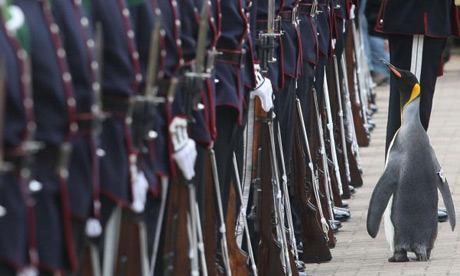
Comparing this – OK, fun – scene with the Russians in Georgia, and noting the latter’s strange decision to go into battle without even a War Puffin as back-up, I was drawn back to the recurrent theme of what Europeans think their troops are for. I’ve only dabbled with the subject, but recalled Daniel’s post in May about the disappearance of martial virtues in Europe. He took Britain as his case-study:
General Richard Dannat, the head of the British army, once remarked that the British Armed Forces are less understood and less honoured for their commitment and sacrifice by ordinary Britons than in comparable societies, like the U.S., and less than in earlier periods.
But this is not unique to Britain. And it is part of two broader inter-related trends: the disappearance of sacrifice as an element of Europe’s development and the divorce of the institution most known for sacrifice – the military – from European society.
And, in the meantime, we increasingly turn to military culture for entertainment, and then are shocked and befuddled when the troops have to go off to war – or other, less postmodern, powers like Russia opt to fight. I’d say more on the subject, but as I’m sat in a cafe in Brooklyn redrafting a pamphlet, I’m slightly conscious that my pondering martial virtues may ring a little a hollow…
by Daniel Korski | Aug 15, 2008 | Conflict and security, Europe and Central Asia
At the risk of sounding morbid, it’s now possible to designate winners and losers in the heats of what will hopefully not become a new Olympic discipline: Russo-Georgian Warfare.
The ex-Soviet heat: Between Medvedev and Shakashvili, the winner’s clearly Russia’s new leader who, while having to initially share the stage with ex-president and former champion Vladimir Putin, was gradually allowed a greater role. Losers include ordinary Georgians and their government.
The ex-Warsaw Pact heat: Strong showing by the leaders of Poland, Ukraine and the Baltic states, but the medal goes to Polish Prime Minister Donald Tusk who announced Thursday that his country had agreed to host 10 American missile-defense interceptors in return for enhanced promise of mutual defense between the U.S. and Poland. Poor showing by the Czech, Slovak and Hungarian leaders – memories of losses in the 1956 and 1968 heats clearly weighed down the contestants.
The US heat: Between Barack Obama and John McCain, the Arizonian comes out on top. On holiday, Obama issued the occasional and concerned-sounding press release while McCain talked daily and tough, building on his tough-guy image. Polls suggest McCain’s come out better than Obama. Worst of all did George W Bush who’s belated reaction to the war’s horrors – preceded by photographed bonhomie with Vladimir Putin – guaranteed a poor showing.
The European heat: The French president has clearly come out on top despite a strong early showing by Sweden’s Carl Bildt who likened Russia’s tactics to those of Nazi Germany. A surprisingly strong showing by Finland’s youthful foreign minister Alex Stubb. One to watch in future competitions.
There was no Middle Eastern, Asian or Central Asian heats whilst the UN pulled out at the last minute.
Correction: In reference to my earlier posting on Georgia’s reconstruction, it has been pointed out that the U.S did not steal a march on the EU’s reconstruction efforts. As David Ringrose, Head of the Information and Communication unit in DG External Relations of the European Commission, points out, the EU’s assistance arm provided € 1 million for medical assistance, water & sanitation, food, blankets, clothes, and shelter for victims of the conflict. I guess the U.S were just better at publicizing their contribution….
