Even before his refusal to rule himself out of any leadership bid on the way to and during his press conference with the Italian Foreign Minister this afternoon (see above), the UK political blogosphere was unanimous about how to interpret David Miliband’s op-ed in the Guardian this morning.
Here, for instance, is Jim Pickard on the FT’s Westminster blog:
Those outside the Westminster village may be bemused that an op-ed (today’s Guardian) on Labour’s future could be seen as a statement of leadership intent. David Miliband’s language is carefully coded.
No such doubts exist here though. There are the omissions (no mention of Gordon Brown), the timing (he could have kept his head low) and the criticisms (he says Labour could have done more to improve the NHS).
The intention of David Miliband’s Guardian article was to cause mischief while Brown is weak. Once decoded, Miliband was sending two clear messages. Firstly, that things need to change. Secondly that he is waiting in the wings … Having ducked out of a leadership contest last year, the biggest danger for Miliband now is that he’s seen to dither – again.
Consider the choices that faced the foreign secretary at a time when there is furious speculation about a challenge to Gordon Brown. Firstly he could have called for that speculation to stop and for people to fall in behind the leader. He did no such thing. Indeed Gordon Brown is not even mentioned in his article. Secondly he could have said nothing at all and simply gone on holiday. But oh no, he chose a third option. To set out the way forward for the party without doing anything to prop up his leader’s position.
Meanwhile, in this evening’s Standard, an ally of the PM (whom Guido Fawkes assumes to be Damian McBride) has this to say:
I think MPs will be appalled. David Miliband has shown himself to be not only disloyal but also self-serving. People at least thought he was a serious figure and a grown-up politician but by allowing his head to be turned by this leadership nonsense, he has revealed a surprising lack of judgment and maturity.
Nick Robinson, though, reckons that
…the foreign secretary has no intention of trying to bring [Gordon Brown] down. On the other hand he does want to make it clear that in this leadership contest – if there is ever one – he will not hesitate, he is ready for the fight. And he will represent the candidate promising change.
I hope my fellow bloggers will forgive me this self-indulgent post, but I could not resist. You see, the FT has a leader about the Afghan drugs trade, arguing:
The first thing to say is that while crop eradication and locking up bad guys may be an important part of addressing the crisis, they are not by themselves a solution. That can only come over years of a sustained and consistent strategy to develop a real market economy which would provide a better livelihood for farmers than the dangerous and volatile drugs business.
That will, it is true, require security and a role for the military. It will mean targeting the middlemen, smugglers and, yes, chemists who operate the infrastructure of the drugs business, hitting their finances and improving co-operation with Afghanistan’s neighbours.
Above all, it will mean that while the small poppy farmer escapes the attentions of the authorities, the big drug barons do not. That demands ending the de facto impunity enjoyed by some Afghans, a move that can be sanctioned by only the president.
Wise counsel; but is it also a little familiar? This is what I wrote on 27 May and again on 4 June this year:
First, the international community must forego the idea that it can sequence coercive and development activities; it is simply not possible given the conditions now or in the foreseeable future. Better therefore not to promise development in exchange for poppy eradication or think conditionality can work.
Second, the international community needs to take aerial eradication off the table and make clear that traffickers, not farmers, are the problem. Because Afghan farmers do not use chemicals, aerial eradication will likely be blamed as the cause of disease, premature deaths or crop destruction, which is a regular but unrelated occurrence in Afghanistan, as in any developing country. The Afghan government, already mistrusted, would suffer from any backlash, thus turning an insurgency into an insurrection.
Instead, the government should focus on rolling out the Afghan state, prioritizing the provision of security to local farmers. The international community, in turn, should focus on building local capacity to maintain security and deliver basic services.
Crucially, this should be coupled with arrests and the prosecution of drug lords and their backers in government. Unless these “narcotics entrepreneurs” are targeted, arrested and prosecuted, little will change. Though, this should be done under the nomenclature of anti-corruption – which Afghans care about – and not of counter-narcotics, which most Afghans think is a Western focus.
The difference lies in the FT’s focus on the development of a market economy and my added point that insecurity comes from the corrupt Afghan police, the reform of which is a sine qua non of an improved counter-narcotics policy. Readers may remember that I advocated drastic solutions to be on the table, including dismantling the Ministry of Interior entirely, placing the police force under the Afghan National Army, or setting up a new gendarmerie-style police initially under the army.
Pardon me, dear readers, but I feel quite pleased with myself. If I could actually spell and string a well-sounding sentence together I too could have been writing FT leaders (even if only on a small and obscure topic). Not a bad feeling to end the day on.
These are testing times, my friends. Testing, troubling, traumatic times. We need a steady hand on the tiller, a good head on the shoulders, a top steerer in the driving seat. We need…Harriet Harman. (Cue Benny Hill-style music).
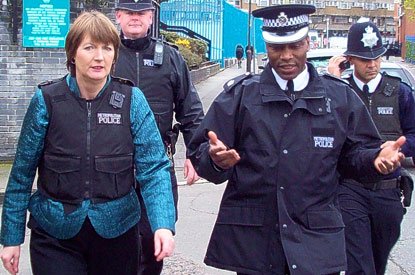
Yes, the sign of quite how bad things have got inside the government is that people are seriously discussing a leadership bid by our Harriet, a politician whose biggest political achievement so far, other than her surprise victory as deputy PM, was to be photographed in a bullet-proof vest as she toured the war-zone in Peckham.
Harman was forced to release a statement denying that she had told colleagues following the Glasgow by-election defeat that ‘this is my moment’. But Harriet, it is! Your country needs you!
Others, sadly, do not share my enthusiasm for Harriet as PM. As the FT rather sniffly put it, ‘If Harriet Harman is the answer, then what is the question?’ Listen, you can’t keep talent down. Who better to lead us in these knife-infested times than a politician with the necessary protection?
Over at The Interpreter, Sam Roggeveen picks up on Alex’s post on Doha to wonder whether a concern for resilience automatically leads to protectionism:
On one level, it makes sense. If the aim of resilience is to build the capability for society to ‘take a punch’ and rebound, whether from a terrorist attack, natural disaster or even a global economic calamity that restricts food imports, it makes sense to have the capacity for local subsistence.
But following that logic to its end would justify continued and even expanded protection of any industry that can be defined as ‘strategic’. Or at a further extreme, it would put you in the company of the survivalist subculture that stockpiles food in the mountains in preparation for the crumbling of civilisation.
I doubt Alex is in favour of such things, but I’d be interested to know how his resilience doctrine escapes that logic.
Let me chip in with two points. First, I really don’t like the ‘bounce back-ability’ definition of resilience (though it’s a term I often slip into using). The aim is to navigate from one ‘solution’ another, not to stick firmly to where you are.
As Alex and I put it in a forthcoming article for Renewal:
In formal terms, resilience is defined as “the capacity of a system to absorb disturbance and reorganize while undergoing change so as to still retain essentially the same function, structure, identity and feedbacks.” (Walker et al 2004). Perhaps the best practical definition we’ve come across is the one offered by the Harvard Business Review. It states that resilience results from being able to face up to reality, improvise in the face of unfamiliar challenges, while finding a source of ‘meaning’ that encourages long-term thinking (Coutu 2002).
Both definitions emphasize the need to change while maintaining a coherent identity. Systems that are brittle, that try to remain static at all costs, are precisely the ones that are most vulnerable to collapse. On the other hand, systems that are flexible, adaptable, that deal with crisis through renewal are the ones that will tend to survive. This is, in other words, a classic collective action problem. The central determinant of a system’s resilience is the ability to act collectively, coherently, and with the right balance between short and long-term interests.
In a high resilience system, risk – and response to that risk – is distributed throughout the system. Individuals and their groups see their interests as compatible with the collective. They have a common understanding of the challenges a society faces and take decisions accordingly, but this understanding is not a straitjacket. Different actors play to the strengths. There is a balance between initiative and co-ordination. In a low resilience system, on the other hand, risks are felt disproportionately by some groups and responses are thus over-centralized. Individuals pursue narrow self-interest; conflict between groups intensifies; and key institutions are increasingly seen as failing to ‘deliver’.
And from this comes my second point. Resilience of what? My starting point would be that the only way of providing any kind of decent life to 6, 7, 8 or 9 billion people is through an interdependent global system. That means building resilience into the international system, and then nesting it into all systems that sit below.
For me, that should rule out protectionism – though not attempts to hedge against a breakdown at the international level. But of course, it won’t. And that’s a problem. Indeed, collapse has been persuasively described by Joseph Tainter as a loss of complexity and retreat into constituent parts.
The process of collapse…is a matter of a substantial decline in an established level of complexity. A society that has collapsed is suddenly smaller, less differentiated and heterogeneous, and characterized by fewer specialized parts; it displays less social differentiation; and it is able to exercise control over the behaviour of its members.
It is able at the same time to command smaller surpluses, to offer fewer benefits and inducements to membership; and it is less capable of providing subsistence and defensive security for a regional population. It may decompose to some of the constituent building blocks…out of which it was created.
Readers of GD will be familiar with my/ our claims that the focus on international terrorism has often been to the detriment of other risks. So interesting to note Richard Mottram comments in the FT recently on the relationship between science, technology and terrorism. From the FT:
The challenge will be to engage a broad range of scientists in the fight against terrorism, without causing an unhealthy imbalance in the scientific enterprise. For instance, the billions of dollars spent by the US government on biodefence over the past few years may have distracted researchers from the fight against infectious diseases. The risk of a flu pandemic – or the emergence of a lethal new disease – is far greater than of a large-scale bioterrorist attack. While there is some scientific crossover between the expertise needed to fight natural and man-made epidemics, it is important to allocate research resources on a balanced view of the risks we face globally.
There’s also an interesting paragraph on why intelligence should draw more on scientific advice:
One lesson to learn from the episode over Iraqi weapons of mass destruction is the importance of ensuring that intelligence analysis and assessment draw on expert scientific advice – and more broadly on the scepticism at the heart of the scientific method. Experts should never again be frozen out of intelligence assessments whose outcome may make the difference between war and peace, as they were in the run- up to the Iraq war.