by Alex Evans | Apr 22, 2008 | Climate and resource scarcity, Global system
I’ve just published a new Chatham House paper on why food prices are rising and what it means for development: download it here.
One of the paper’s main arguments is that we need to make sure that the urgent doesn’t crowd out the essential in discussions of global food strategies: immediate action on humanitarian assistance needs to be matched by a sustained effort to invest in shared awareness between policymakers of what needs to be done to achieve “the feeding of the ten billion”. From the press release:
While the current focus on humanitarian aid is welcome, we need to be thinking now about the long term, too – especially how to grow food supply and make sure that the process benefits rural poor people. What we’re seeing now is just the start of a multi-decade challenge: feeding a global population set to approach ten billion by 2050, in the face of climate change, tighter energy supply, and growing competition for land and water resources.
How we frame and perceive the issue matters enormously. If the prevailing narrative is a Malthusian story of insufficiency, then the risk is of self-fulfilling prophecy – if for example fears that there isn’t enough to go around lead to countries panic-buying food for stockpiles, pushing prices up even more. Instead, we need to see this as a transition to a new stable state. Feeding a world population of ten billion people in 2050 won’t be easy, but it can be done with forethought, collective action and if we don’t panic.
Update: coverage on Associated Press, The Independent and Channel 4 News. One of the many pleasing aspects of publishing things through Chatham House is the general assumption that any of their authors will be as august as the Institute itself. Thus the Independent has kindly conferred upon me a doctorate that I’m fairly sure I do not have; more recently, El Pais has promoted me to Professor.
by Daniel Korski | Apr 22, 2008 | Africa, East Asia and Pacific, Europe and Central Asia
Later in the week half of the European Commission will go to Beijing. Playing Kissinger to EU President Barroso’s Nixon, Trade Commissioner Peter Mandelson has prepared the way for his boss with a thoughtful speech to the China-Britain Business Council.
Instead of boycotting the Olympics, Mandelson argues that China should be treated with respect – but asked to make quick concessions on its trade tariffs, as part of the Doha round of trade talks. For this proposal he gets full marks from the The Times.
But Mandelson’s approach is unlikely to satiate Western publics’ concerns about Beijing’s crack-down in Tibet, its human rights record or its behaviour in Africa (the subject of a conference in Berlin this week). Furthermore, while the Doha round will benefit many African countries – including by removing tariffs on import of many African goods to China – trade, as we know, is not enough to alleviate poverty.
So what should Europe do? The EU commission’s visit should not only be an opportunity to establish on-going contact between the two trading partners (although this if, of course, important); it represents a chance for the EU to lay out a strategic agenda for what it expects China to do, including in Africa.
Key “asks” of China should include getting Beijing to support the Extractive Industries Transparency Initiative (EITI), joining the G8 African Partner’s Forum and committing to undertaking all aid projects in Africa with an OECD donor of IFI. Now that we are at it, what about a joint EU/China/AU study of the impact of China’s investments? Sure, it would have to phrased differently.
Mandelson’s right to call for a sober assessment of the benefits of EU-China relations. But any “deal” between the two needs to go beyond commerce and trade. In American political folklore, Nixon opened the door to China. Barroso should work to ensure that what comes through that door in the next fifty years benefits not only China but the EU as well as the developing world.
by Alex Evans | Apr 22, 2008 | Off topic
From Gizmodo, a terrible tale of technology, misunderstanding and revenge. Our story begins in Turkey, where Emine and Ramazan are in the process of separating. After deciding to split, they continue to hurl barbs at each other by text message – including one from Ramazan in which he accuses his wife thus:
You change the topic every time you run out of arguments.
Problem was, the whole meaning of the sentence hinged on Emine’s cellphone’s capacity to understand a special Turkish alphabet character called a ‘closed i’ – and it couldn’t, because of faulty localisation of the hardware. As a result, the message that Emine actually received read like this:
You change the topic every time they are fucking you.
At this point,
Emine then showed the message to her father, who—enraged—called Ramazan, accusing him of treating his daughter as a prostitute. Ramazan went to the family’s home to apologize, only to be greeted by the father, Emine, two sisters and a lot of very sharp knives.
Injured and bleeding, with a knife on his chest, Ramazan tried to escape. Emine was still trying to finish him on the door, but he managed to take the knife out of his chest and attacked back, wounding her. Ramazan finally escaped, and was caught by the police, but Emine bled to dead as the family waited for an ambulance to cross Ankara’s hellish traffic to reach their home. Confused by all the events, he later killed himself in jail.
Blimey.
by Alex Evans | Apr 22, 2008 | Conflict and security, Middle East and North Africa, South Asia
Barney Rubin has an excellent post updating on latest developments in Pakistan’s federally administered tribal areas. Start, he says, from a clear recognition of one thing at least: the US has no plan. Here’s a graph from the US Government’s General Accountability Office which proves the point:
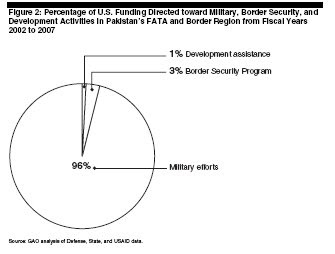
Note especially the amount being allocated to political reform, he says: 0%. Meanwhile, Khalid Aziz – the former chief secretary of NWFP – has been doing some serious strategising about what needs to happen next (in the wake of Pakistan’s elections – which as the BBC put it “saw an overwhelming vote for parties that advocate secularism, or the separation of religion from politics” in the NWFP). Aziz writes:
…the Feb 18 election has clearly indicated that the people of Pakistan voted against militarism and violence. The Taliban recognise that resort to force alone will not lead to the achievement of their main political objective which is the creation of an Islamist Caliphate.
However, while everyone waits for good sense to prevail, there may be forces amongst the non-state fighters planning another strike in the West. If that happens, one may be certain of an air war in FATA and this could lead to incalculable harm to Pakistan. This in a nutshell is the danger surrounding the process of talks. . . .
Many conservative Pakhtuns believe that the fighting in Swat, Kohat and Waziristan is a war of liberation against US occupation of Afghanistan; they fight the Pakistani state because of its alliance with the US. However, it does not make it a US war alone. Whatever may be the case at the start, this is now Pakistan’s war, since the objective of the insurgents is to change the nature of the Pakistani state. To fellow Pakistanis I would say that it is our war, whether we like it or not.
Compare that, Rubin says, to Musharraf – with whom “all negotiations with militants… had as their aim to balance the imperative of acting against al–Qaida with that of saving the Taliban as a strategic asset for Pakistan”. His conclusion:
We now have a full partner in Pakistan, elected, ironically enough, by Pakistani voters angry at what the GAO calls the “lack of a comprehensive plan,” rather than just a military approach. It is indeed time to “sit down and think through what we can collectively do” with these partners.
