On Saturday, Alex and I presented our paper on multilateralism and global risks to heads of state at the Progressive Governance Summit, which was chaired by Gordon Brown.
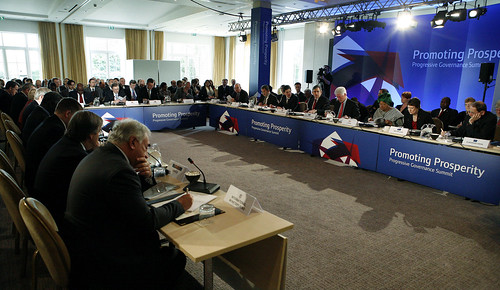
The summit was held at the Grove Hotel in Watford – which is more used to hosting the England football team and posh weddings. Locals – who were warned they would be searched before entering the hotel’s spa – seemed less than impressed at the interruption, though a few did manage to sneak in for a round of golf (though perhaps they were snipers in disguise).
And inside? We got a nice plug from Helen Clark, New Zealand’s PM, and from Africa’s first elected female head of state, Ellen Johnson-Sirleaf. Bill Clinton was also lucky enough to be collared by Global Dashboard’s Charlie Edwards on his way back from the lav, which I am sure was a highlight for both of them.
In discussion, two topics predominated. First, the global financial meltdown, with Kevin Rudd (surely the wonkiest head of state ever) fretting that ‘technology has got ahead of the regulatory environment,’ or in other words, men with computers are doing stuff with money that no-one, including the men themselves, really understands or can control.
A few leaders, Austria’s Alfred Gusenbauer among them, were calling for a World Finance Organisation to be created as an institutional big brother to the WTO (can you imagine the protests outside a WFO annual meeting?). But most were happy to settle for a revamped IMF to act as an ‘early warning system’ and for rapid action to, in the words of the head of the IMF, “disentangle the good and the bad banks”.
A global trade deal was also seen as a vital part of restoring confidence, with the WTO’s Pascal Lamy making it sound as if the conclusion of a ‘strong pro-development, pro-growth round’ was just around the corner. Peter Mandelson, who leads on trade for the Europeans, was a little less bullish, I thought.
Mandelson agreed that ‘night and day drilling’ into the detail of a proposed agreement was yielding results, but he argued that any further delay could be fatal for a deal. 2009 should be written-off, he said, due to a changing of the guard in the US in the first half of the year and in the European Commission in the second. Any agreement would have ‘turned to mush’ by 2010, he concluded.
It was a provocative point and a worrying one, given that 2009 is supposed to be the year the world does a deal on climate. How’s that going to work if everyone is too busy settling into new jobs to pay attention?
I thought the climate discussion was rather disappointing, despite Kevin Rudd’s attempt to muscle some shape into it. The climate paper was presented by Laurence Tubbiana (co-author Nick Stern had a more pressing engagement!) and she set out the same ‘seven elements for a global deal’ that Stern was promoting at Bali. It’s an unobjectionable list, but I am unconvinced by Tubbiana and Stern’s optimism that a deal will be easily struck.
Their framework, they argue, could “allow all countries to move quickly along what they see to be a responsible path”.
What is very striking here is how broadly basic understandings have already been established. Country-by-country we see targets being erected and measures being set by individual countries recognising their own responsibilities as they see international agreement being built. People seem to understand the arguments for action and collaboration on climate change much more readily than they do for international trade.
In the discussion, it was clear that leaders accepted the need for targets. After all, who doesn’t? But there seemed very little consensus on who should do what. It’s only when countries start to work out whether a global deal seems fair to them that we’ll really know whether or not it’ll be a rocky road to Copenhagen.
But climate felt like a little bit of a sideshow, with leaders keen to spend time on another scarcity problem – food. This is an area where my co-author, Alex Evans, is carrying out pioneering work (also see this summary) and it was clear how worried leaders are by rocketing prices.
But will that make any difference? In my part of our presentation (we’ll have text and perhaps some video later), I wondered whether food was going to be another ‘slow motion car crash’ like HIV/AIDS twenty years ago. Is it one of those problems that everyone can see coming, knows is going to be catastrophic, but is unable to do anything useful about? Time will tell.