by David Steven | Jan 15, 2008 | Off topic
It’s Wikipedia’s seventh birthday today – and we’re being treated to all the usual statistics about how vast the site has become. Nine million articles. 250 languages. Ninth most popular site on the interweb. etc. etc.
But one stand-out figure is seldom noted. Just how ridiculously cheap the website is to run – around $75k a month which covers not just Wikipedia itself, but all the other sites in the Wikimedia family.
Now capital costs (buying lots and lots of servers) also have to be factored in. The Wikimedia foundation is currently looking to spend around $1.6m on another 600 machines (you can donate money here).
But, all in all, what an absurd, remarkable bargain…
by Alex Evans | Jan 15, 2008 | Climate and resource scarcity, Global system
A coalition of international shipping companies have banded together to create a ‘Container Shipping Information Service’ to counter what they worry may be an increasingly negative image. As FT coverage explains,
There has been particularly strong criticism in Hong Kong – which, with neighbouring Shenzhen, handles about 28 per cent of world container movements – and southern California, which handles 40 per cent of US container imports. Research published last year claimed 60,000 people died each year as the result of ships’ high levels of sulphate emissions.
The shipping lines are also nervous of growing calls in the US for all containers to be searched before being sent to the US, because of the perceived threat of a container-borne terrorist weapon. Information put out by the service … will stress the benefits brought by container shipping, particularly the sharp reduction in global transport costs achieved by the industry.
One of the bits of data posted on the site is a graph comparing the CO2 emissions from moving a ton of cargo 1 kilometre with the emissions that would result from moving it instead by rail, road or air. For shipping, the figure is 12.97 grammes of CO2 – as opposed to 17 grammes for rail, 50 for road and 552 for air. Presumably, the shipping companies involved think this constitutes a good argument in shipping’s favour. But in fact, the surprise is that shipping’s emissions are so high relative to the other three transport modes, rather than so low.
It’s no great shock to see aviation emissions outstripping shipping’s by such a big margin – but remember that air freight is used for much smaller volumes and weights of cargo, usually of highly perishable goods. The fact that shipping emissions are all of two thirds of those of rail, though – and well over a fifth of those of heavy goods vehicles on the road – is really surprising.
I would have expected shipping to be a great deal more efficient than that, given the massive volume of cargo that a 3,700 TEU container ship can carry. The fact that shipping’s CO2 emissions are in the same order of magnitude as those of road and rail – which move much smaller cargoes over much shorter distances – places a pretty big question mark over the long term viability of bulk trade in food and raw materials. It also makes for a strong argument in favour of what development advocates have wanted for years: value-added processing and manufacture from raw materials to take place before export.
by Alex Evans | Jan 15, 2008 | Influence and networks, UK
Gideon Rachman caused me to laugh out loud on a crowded Northern Line tube train earlier this morning, causing startled glances from my fellow passengers. His column this week is a reflection on the thrill of political power – a subject, he noted, that he gained some insight into recently when
I had lunch with a friend who had helped to handle a national emergency in Britain, working from the emergency bunker known as Cobra – which sits beneath the Cabinet Office near Downing Street. “What was it like?” I asked him. “Brilliant,” he replied. “There are all these video screens and generals and admirals sitting around in uniform. You have to say things like: ‘It is 3.45pm and I am now bringing to a close this meeting of Cobra emergency command.’”
Is my friend uniquely juvenile? I suspect not – just unusually honest. He certainly believed that all the other officials around the table were delighting in the little rituals of crisis management. “I guarantee that everybody around that table had an erection within five minutes,” he mused.
Extrapolating slightly, my friend developed what you might call “the erection theory of British foreign policy”. His argument was that British government’s bias towards the “special relationship” with the US, in preference to the European Union, has something to do with the thrilling nature of American power. “If you fly into Camp David on a helicopter,” he assured me, “it’s instant arousal. But if you have to go to a European summit in Brussels, its so depressing you’re impotent for a week.”
Of course, the obvious question is: who was Gideon’s excitable lunchtime interlocutor? Well, we know that:
(a) It’s a man;
(b) He must presumably have been chairing, rather than merely attending, the COBRA meeting, if it was his job to adjourn the meeting (which means that he was representing the lead department – see the helpful COBRA diagram on page 47 of Charlie Edwards’ last Demos pamphlet on national security) ;
(c) It’s someone who’s been to Camp David, by helicopter; and
(d) It’s presumably someone who works in foreign policy, given that he’s lunching with the FT’s chief foreign affairs columnist.
Answers on a postcard…
by Alex Evans | Jan 15, 2008 | Conflict and security
The NY Times has this sorry tale:
Late one night in the summer of 2005, Matthew Sepi, a 20-year-old Iraq combat veteran, headed out to a 7-Eleven in the seedy Las Vegas neighborhood where he had settled after leaving the Army. This particular 7-Eleven sits in the shadow of the Stratosphere casino-hotel in a section of town called the Naked City. By day, the area, littered with malt liquor cans, looks depressed but not menacing. By night, it becomes, in the words of a local homicide detective, “like Falluja.”
Mr. Sepi did not like to venture outside too late. But, plagued by nightmares about an Iraqi civilian killed by his unit, he often needed alcohol to fall asleep. And so it was that night, when, seized by a gut feeling of lurking danger, he slid a trench coat over his slight frame — and tucked an assault rifle inside it. “Matthew knew he shouldn’t be taking his AK-47 to the 7-Eleven,” Detective Laura Andersen said, “but he was scared to death in that neighborhood, he was military trained and, in his mind, he needed the weapon to protect himself.”
Head bowed, Mr. Sepi scurried down an alley, ignoring shouts about trespassing on gang turf. A battle-weary grenadier who was still legally under-age, he paid a stranger to buy him two tall cans of beer, his self-prescribed treatment for post-traumatic stress disorder. As Mr. Sepi started home, two gang members, both large and both armed, stepped out of the darkness. Mr. Sepi said in an interview that he spied the butt of a gun, heard a boom, saw a flash and “just snapped.”
In the end, one gang member lay dead, bleeding onto the pavement. The other was wounded. And Mr. Sepi fled, “breaking contact” with the enemy, as he later described it. With his rifle raised, he crept home, loaded 180 rounds of ammunition into his car and drove until police lights flashed behind him. “Who did I take fire from?” he asked urgently. Wearing his Army camouflage pants, the diminutive young man said he had been ambushed and then instinctively “engaged the targets.” He shook. He also cried. “I felt very bad for him,” Detective Andersen said.
Thing is, this kind of story has been amply predicted by 4GW theorists like Bill Lind and John Robb. Here, for instance, is Lind – writing over a year ago – on the ‘boomerang effect‘:
When a state involves itself in 4GW over there, it lays a basis for 4GW at home. That is true even if it wins over there, and all the more true if it loses, as states usually do. The toxic fallout from America’s 4GW defeats in Iraq and Afghanistan will be far greater than most people expect, and it will fall most heavily on America’s police.
And as Lind explains in the same article, highly trained servicemen suffering from post-traumatic stress are the least of the police’s worries. What about those with a grudge against the government that sent them to war?
One of the things U.S. troops are learning in Iraq is how people with little training and few resources can fight a state. Most American troops will see this within the framework of counterinsurgency. But a minority will apply their new-found knowledge in a very different way. After they return to the U.S. and leave the military, they will take what they learned in Iraq back to the inner cities, to the ethnic groups, gangs, and other alternate loyalties they left when they joined the service. There, they will put their new knowledge to work, in wars with each other and wars against the American state. It will not be long before we see police squad cars getting hit with IEDs and other techniques employed by Iraqi insurgents, right here in the streets of American cities.
I know this thought – not to speak of the reality when it happens – will be shocking to some readers. To anyone who really understands Fourth Generation war, it should not be. Fourth Generation war does not merely work on the will of a state’s political leaders, as some theorists have said. It does something far more powerful. It pulls an opposing state apart at the moral level.
The Bush administration, as usual, has it exactly backwards. The danger is not that the “terrorists” we are fighting in Iraq will come here if we pull out there. Rather, American involvement in 4GW in Iraq will create “terrorism” here from among the people we have sent to fight the war there. Well educated in the ways of successful insurgency, they will come home embittered by a lost war, by friends dead and crippled for life to no purpose. Thanks to America’s de-industrialization, they will return to no jobs, or lousy “service” jobs at minimum wage. Angry, frustrated and futureless, some of them will find new identities and loyalties in gangs and criminal enterprises, where they can put their new talents to work.
It will, of course, be only a small minority of returning troops who will go this route. But something else they will have learned from the Iraqi insurgents, along with how to make and deploy IEDs, is that it takes very few people to create and sustain an insurgency.
by Alex Evans | Jan 15, 2008 | Conflict and security, Cooperation and coherence, Influence and networks
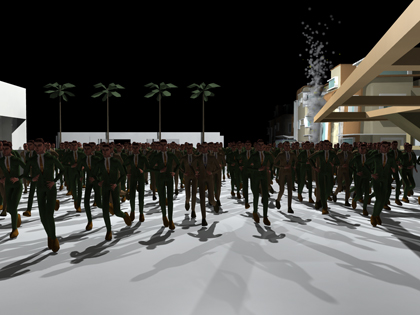
Regular readers will know that we do love a good old-fashioned urban panic here at Global Dashboard. So imagine the delight here when Bruce Schneier noted yesterday that Paul Torrens of the Arizona State University School of Geographical Sciences has devised a new computer simulation that models urban panic. Torrens’ own website has some very cool animated simulations of crowd behaviour, plus urban growth and sprawl too.

Torrens explains that “the goal of this project is to develop a reusable and behaviorally founded computer model of pedestrian movement and crowd behavior amid dense urban environments, to serve as a test-bed for experimentation. The idea is to use the model to test hypotheses, real-world plans and strategies that are not very easy, or are impossible to test in practice.” Schneier cites some examples which already have us drooling with envy and anticipation:
1) simulate how a crowd flees from a burning car toward a single evacuation point;
2) test out how a pathogen might be transmitted through a mobile pedestrian over a short period of time;
3) see how the existing urban grid facilitate or does not facilitate mass evacuation prior to a hurricane landfall or in the event of dirty bomb detonation;
4) design a mall which can compel customers to shop to the point of bankruptcy, to walk obliviously for miles and miles and miles, endlessly to the point of physical exhaustion and even death;
5) identify, if possible, the tell-tale signs of a peaceful crowd about to metamorphosize into a hellish mob;
6) determine how various urban typologies, such as plazas, parks, major arterial streets and banlieues, can be reconfigured in situ into a neutralizing force when crowds do become riotous; and
7) conversely, figure out how one could, through spatial manipulation, inflame a crowd, even a very small one, to set in motion a series of events that culminates into a full scale Revolution or just your average everyday Southeast Asian coup d’état — regime change through landscape architecture.
Or as Pruned puts it more colourfully, you could decide to
… quadruple the population of Chicago. How about 200 million? And into its historic Emerald Necklace system of parks, you drop an al-Qaeda sleeper cell, a pedophile, an Ebola patient, an illegal migrant worker, a swarm of zombies, and Paris Hilton. Then grab a cold one, sit back and watch the landscape descend into chaos. It’ll be better than any megablockbuster movie you’ll see this summer.
