by David Steven | Oct 28, 2007 | Climate and resource scarcity, Influence and networks
One addendum to Alex’s discussion of the new paper from Gerard Roe and Marcia Baker, which argues that we will never really know how much warming we are letting ourselves in for…
Isn’t that exactly why climate change is frightening? We’re poking a complex and poorly understood system with a very big stick – and we don’t know how it’s going to react (although there are plenty of reasons to believe it could be ugly).
Yet we insist in framing this as a problem of certain consequences rather than uncertain ones. It’s a big mistake in my book.
Update: Cf this quote from the Stern Review (chapter 13):
Uncertainty is an argument for setting a more demanding long-term policy, not less, because of the asymmetry between unexpectedly fortunate outcomes and unexpectedly bad ones.
by Alex Evans | Oct 28, 2007 | Conflict and security, Influence and networks
From the Chicago Sun-Tribune, via Crooked Timber:
The Federal Emergency Management Agency’s No. 2 official apologized Friday for leading a staged news conference Tuesday in which FEMA employees posed as reporters while real reporters listened on a telephone conference line and were barred from asking questions. … FEMA announced the news conference at its headquarters here about 15 minutes before it was to begin Tuesday afternoon, making it unlikely that reporters could attend. Instead, FEMA set up a telephone conference line so reporters could listen.
In the briefing, parts of which were televised live by cable news channels, Johnson stood behind a lectern, called on questioners who did not disclose that they were FEMA employees, and gave replies emphasizing that his agency’s response to this week’s California wildfires was far better than its response to Hurricane Katrina in August 2005.
“It was absolutely a bad decision. I regret it happened. Certainly … I should have stopped it,” said John “Pat” Philbin, FEMA’s director of external affairs. “I hope readers understand we’re working very hard to establish credibility and integrity, and I would hope this does not undermine it.”
Thank you, John-Pat. Now go and write out a hundred times: “I will remember that legitimacy is the bedrock of effective public diplomacy”.
by Alex Evans | Oct 28, 2007 | Climate and resource scarcity
Two scientists, Gerard Roe and Marcia Baker, have a paper in Science this week which is a must read for everyone in climate policy. Here’s the abstract:
Uncertainties in projections of future climate change have not lessened substantially in past decades. Both models and observations yield broad probability distributions for long-term increases in global mean temperature expected from the doubling of atmospheric carbon dioxide, with small but finite probabilities of very large increases. We show that the shape of these probability distributions is an inevitable and general consequence of the nature of the climate system, and we derive a simple analytic form for the shape that fits recent published distributions very well. We show that the breadth of the distribution and, in particular, the probability of large temperature increases are relatively insensitive to decreases in uncertainties associated with the underlying climate processes.
What that means, essentially, is that the climate system is so inherently complicated – because of internal variables like snow cover, clouds or water vapour in the atmosphere – that it’s just not possible to put specific numbers on ‘x amount of CO2 = y degrees C of warming’. Here’s Scientific American this week, with an interview of the paper’s authors:
Some of these feedback processes are poorly understood—like how climate change affects clouds—and many are difficult to model, therefore the climate’s propensity to amplify any small change makes predicting how much and how fast the climate will change inherently difficult. “Uncertainty and sensitivity are inextricably linked,” Roe says. “Some warming is a virtual certainty, but the amount of that warming is much less certain.” Roe and his U.W. co-author, atmospheric physicist Marcia Baker, argue in Science that, because of this inherent climate effect, certainty is a near impossibility, no matter what kind of improvements are made in understanding physical processes or the timescale of observations.
Why does this matter for policymakers? Because it puts a question mark over the current emphasis in policy debates on limiting warming to 2 degrees C (c.f. discussion of temperature limits at the recent UN climate summit). How can you limit warming to 2 degrees, or any other number, if you’re not sure what that equates to in terms of a parts per million ceiling on carbon dioxide in the air? Here’s Scientific American again:
…targets such as stabilizing atmospheric concentrations of CO2 at 450 parts per million (nearly double preindustrial levels) to avoid more than a 3.6 degree F (2 degree C) temperature rise are nearly impossible as well. There is no guarantee that such a target would achieve its stated goal. “Policymakers are always going to be faced with uncertainty and so the only sensible way forward to minimize risk is to adopt an adaptive policy,” argues climatologist Gavin Schmidt of the NASA Goddard Institute of Space Studies, “which adjusts emissions targets and incentives based on how well, or badly, things are going.”
So, while it still makes sense to use the IPCC estimate that limiting warming to between 2.0 and 2.4 degrees C means limiting CO2e levels to between 445 and 490ppm (and hence reducing global emissions by between 60 and 85 per cent by 2050), what Roe and Baker’s research really underlines is: focus on the CO2, not the temperature. For all that 2 degrees makes a nice advocacy position for NGOs, the problem with temperature limits has been that they just don’t equate directly to emissions targets in the way that concentration limits to.
Which is why David and I have always called for stabilisation limits in ppm terms, not degrees C – and have also stressed that the key thing is to make the CO2 ceiling revisable in the light of emerging science.
by Mark Weston | Oct 26, 2007 | Europe and Central Asia, Middle East and North Africa
Most commentators on the Congressional resolution commemorating the Armenian genocide have adopted a US-centric view. Andrew Sullivan describes the move as “foolish in the extreme” because it will antagonize a key US ally. The University of San Francisco’s Stephen Zunes supports the decision because it is vital for the US to uphold its “longstanding principles.” But it’s not all about America – Turkey has some questions of its own to answer.
The row over the Armenian genocide and the threatened incursion into Iraqi Kurdistan are two sides of the same kuru? for Turkey. Ninety years after the break-up of the Ottoman Empire, Turks still inhabit a foreign policy realist world, where all your neighbours want a chunk of your territory and the criticisms of far-off superpowers mask their real goals of gaining influence within your borders and weakening your global standing. (more…)
by David Steven | Oct 24, 2007 | Climate and resource scarcity, North America
As I am sure you are all aware its Islamo-Fascism awareness week on US campuses:
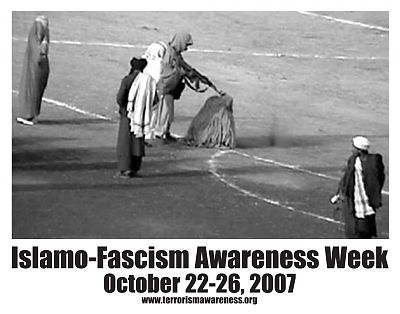
By the way, the enemy is now climate change, not just Bin Laden:
The purpose of this protest is as simple as it is crucial: to confront the two Big Lies of the political left: that George Bush created the war on terror and that Global Warming is a greater danger to Americans than the terrorist threat.
